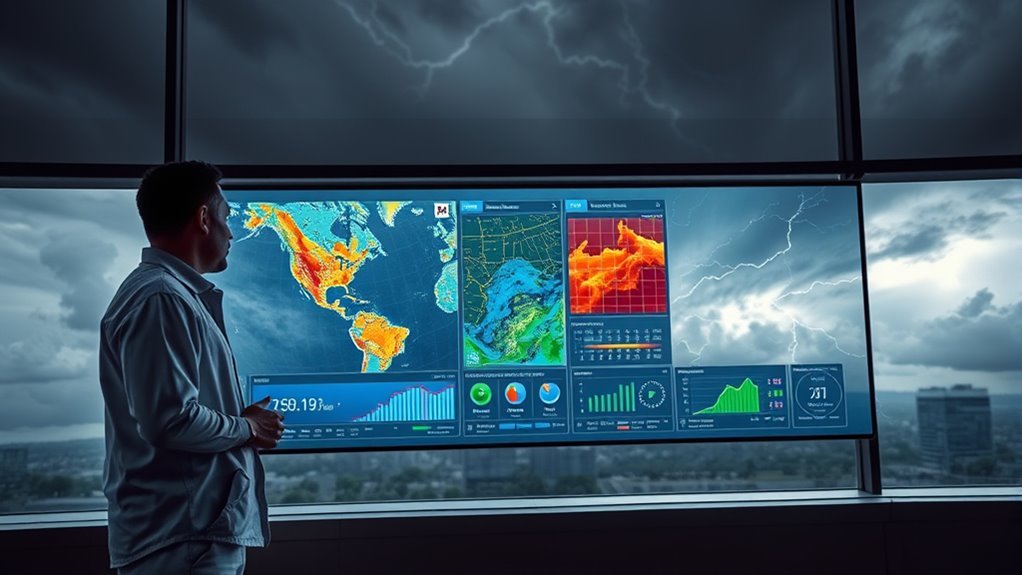
How Does Weather Intelligence Work?
Weather intelligence is all about harnessing data to provide you with insightful predictions and actionable insights tailored to your specific needs.
It works by collecting information from satellites, sensors, and sophisticated weather models.
This data is then analyzed to deliver real-time updates while considering operational contexts.
With this approach, you can anticipate risks and opportunities that may impact your assets or plans.
By utilizing weather intelligence, you can make smarter, faster decisions without getting bogged down by irrelevant information.
Understanding this process can significantly enhance efficiency and safety across various industries, allowing you to stay ahead of the curve.
So, whether you’re in agriculture, logistics, or any other field, weather intelligence is a game-changer for strategic planning.
Defining Weather Intelligence and Its Purpose
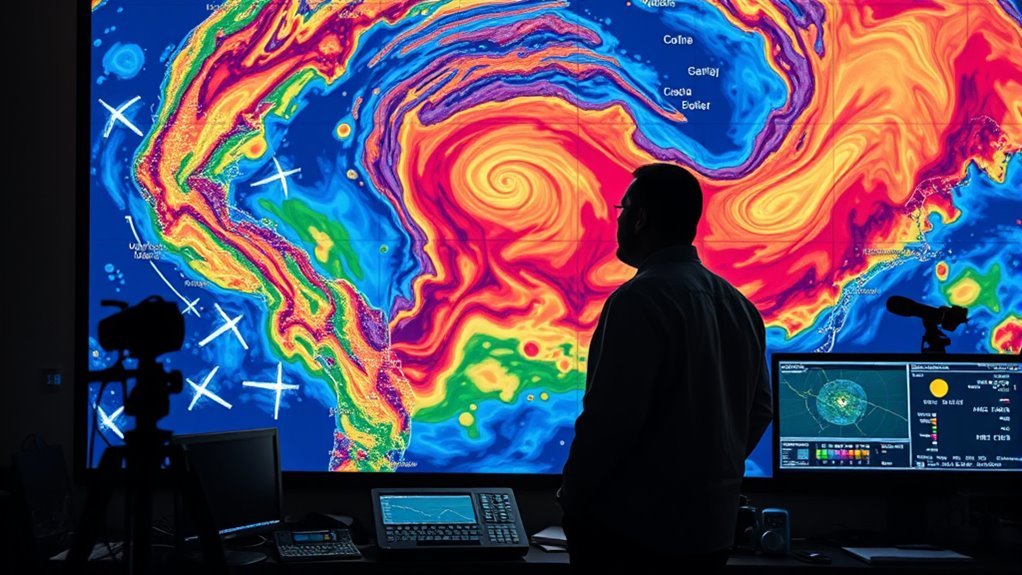
Although weather forecasts provide raw data, weather intelligence goes a step further.
Weather intelligence transforms basic forecasts into actionable insights for smarter decision-making.
It collects and analyzes information from satellites, sensors, and models to give you actionable insights.
You don’t just get weather data—you get an interpreted view that helps you make smarter decisions.
Weather intelligence combines diverse data sources, turning complex meteorological information into clear guidance tailored to your specific needs.
This allows you to anticipate weather impacts on your assets, operations, and locations.
By planning proactively, you can reduce risks more effectively.
By translating raw weather data into strategic insights, weather intelligence empowers you to respond effectively to weather-related threats.
It also helps you seize opportunities, giving you a competitive edge in managing environmental challenges.
Key Components and Data Sources
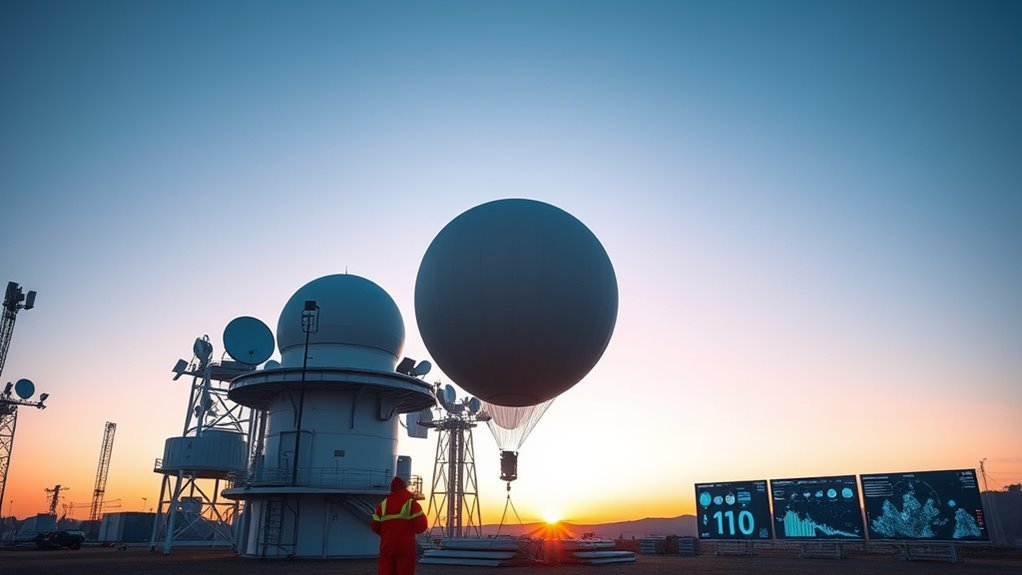
To deliver accurate and actionable weather intelligence, the system depends on key components and diverse data sources that work together seamlessly.
You’ll find data coming from satellites, ground-based sensors, radars, and weather stations, each playing a vital role.
Satellites provide broad, global data like cloud cover and storm tracking, while ground sensors and radars offer localized, high-resolution data essential for pinpointing weather conditions.
These sources gather real-time and historical information on temperature, humidity, wind speed, and solar radiation.
Together, this extensive data forms the foundation for monitoring atmospheric conditions.
Data Analysis and Forecasting Techniques
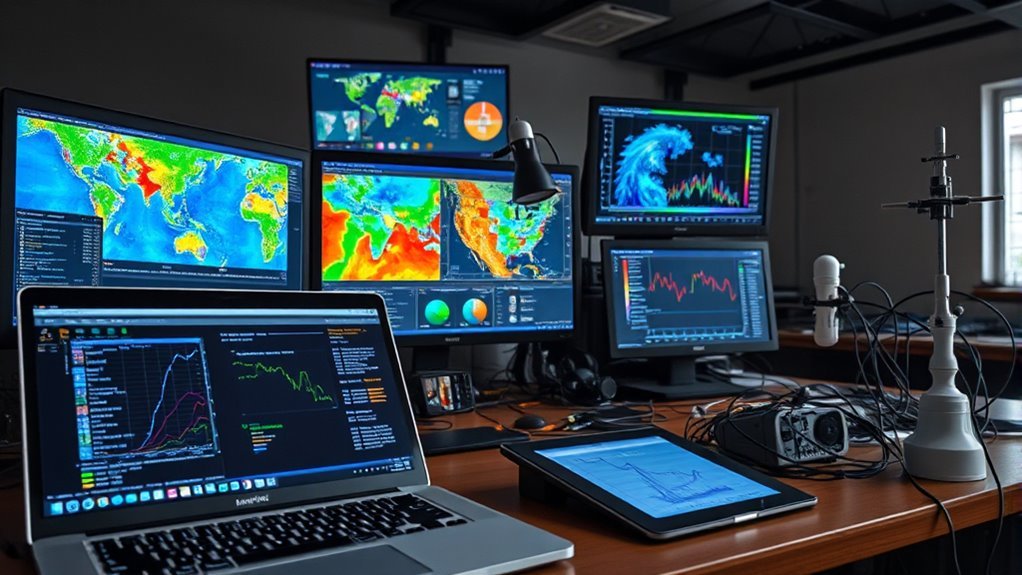
You rely on data collection methods like satellites and ground sensors to gather real-time information.
Then, predictive modeling approaches use this data to generate accurate weather forecasts.
Data Collection Methods
When you want accurate weather forecasts, collecting data from various sources like satellites, ground sensors, radars, and weather stations is essential.
This weather data captures real-time atmospheric conditions worldwide, forming the foundation for analysis and forecasting. Each data source offers unique insights, ensuring a thorough understanding of weather patterns.
| Data Source | Function |
|---|---|
| Satellites | Monitor large-scale weather |
| Ground Sensors | Measure temperature, humidity |
| Radars | Track precipitation |
| Weather Stations | Record local atmospheric data |
| Buoys | Collect marine weather data |
Predictive Modeling Approaches
Collecting diverse weather data sets the stage for predictive modeling, where sophisticated algorithms analyze this information to forecast future conditions.
You’ll see predictive modeling rely on statistical algorithms and machine learning to process historical and current data, including satellite imagery and radar inputs.
Numerical weather prediction models solve complex atmospheric physics equations, simulating weather patterns for specific timeframes.
Ensemble forecasting enhances accuracy by running multiple models with varied initial conditions, giving you probabilities and confidence levels for predictions.
These advanced techniques also factor in operational thresholds and contextual details, helping you generate actionable insights tailored to your industry or assets.
Real-Time Data Integration
How can weather intelligence stay accurate and timely in an ever-changing atmosphere?
It does so by integrating real-time data from satellites, ground sensors, and radar, giving you a current snapshot of atmospheric conditions.
This continuous stream of information undergoes advanced data analysis to spot patterns and anomalies quickly.
Forecasting models then apply statistical algorithms and numerical weather prediction to generate up-to-date short- and long-term forecasts.
Because the data flows constantly, forecasts can be dynamically updated, ensuring you always have the latest insights for decision-making.
To maintain reliability, rigorous data quality control and validation processes check the accuracy of the real-time data.
Integrating Weather Intelligence Into Decision-Making
To make weather intelligence truly useful, you need to define clear operational thresholds that trigger specific actions.
Assigning decision ownership guarantees everyone knows their role when weather risks arise.
Operational Thresholds Defined
When weather conditions reach specific levels, operational thresholds trigger actions tailored to your assets, locations, and roles.
These predefined criteria activate when weather data meets or exceeds set levels, ensuring you respond promptly and appropriately.
By integrating weather intelligence, you continuously monitor conditions, detecting when operational thresholds are approached or crossed.
Clear thresholds help you prioritize responses, preventing delays caused by uncertain or conflicting information.
Establishing these limits lets your team escalate alerts and coordinate actions proactively, based on forecast confidence and severity.
This approach keeps your decision-making focused and relevant, so you can protect assets and maintain safety without hesitation.
Operational thresholds are essential for turning raw weather data into timely, actionable steps that fit your unique operational needs.
Decision Ownership Assigned
Although weather intelligence provides critical insights, you need clear decision ownership to act on them effectively.
Assigning decision ownership means designating specific roles or teams to interpret weather data, assess risks, and initiate necessary actions.
This clarity prevents delays by ensuring the right people are empowered to respond promptly.
You’ll also establish escalation procedures and predefined thresholds so decisions happen smoothly as conditions change.
To keep decision ownership effective, continuous training and communication are essential.
This allows your team to adapt responses as weather evolves.
Without clear decision ownership, weather intelligence risks being underutilized or ignored, reducing its value in your organization’s operations.
Workflow Integration Strategies
Clear decision ownership sets the stage for integrating weather intelligence into your daily workflows.
Effective workflow integration strategies let individuals and organizations turn weather information into a single source for making informed decisions.
By mapping weather risks to assets and roles, you guarantee decisions based on weather reach the right people promptly.
Embedding weather intelligence to support operational systems helps you automate alerts and reports, boosting operational efficiency and public safety.
This lets you translate weather predictions into proactive decisions that keep people safe during extreme temperatures or severe events.
Regularly reviewing your integration approach ensures weather becomes a reliable tool, helping you adapt and refine how you use weather data.
With these strategies, you can confidently turn weather into actionable insights that safeguard your team and optimize outcomes.
The Role of Context, Confidence, and Timing
Because effective decision-making depends on it, understanding the role of context, confidence, and timing in weather intelligence is essential.
You need context to link weather data to your specific assets, locations, and operational thresholds. This ensures that the information is relevant and actionable.
Confidence comes from evaluating the likelihood, severity, and lead time of weather events. This helps you trust forecasts and plan accordingly.
Timing is critical too; you require insights early enough to escalate responses as confidence grows.
By integrating operational context with precise data analysis, weather intelligence provides clear decision triggers.
Prioritizing timely, relevant information lets you act decisively—not just reactively—when weather threats arise.
This approach improves your ability to safeguard operations and minimize risks effectively.
Challenges of Excess Weather Data
When you’re faced with an overload of weather data, making clear decisions becomes a real challenge.
You might find yourself stuck in analysis paralysis, overwhelmed by conflicting information from multiple sources.
It’s tough to know which guidance to trust when high-resolution models and countless alerts flood your system.
This overload leads to alert fatigue, making you less responsive to critical warnings.
On top of that, irrelevant data or non-operational thresholds can distract you from the real weather risks that need your attention.
Without proper filtering and contextualization, all this excess information slows down your ability to act promptly and effectively.
Managing this flood of data is essential if you want weather intelligence to truly support your decision-making.
Industry Applications and Use Cases
Handling vast amounts of weather data is just the first step; putting that information to work transforms it into real value.
You can optimize planting schedules and irrigation in agriculture by using precise forecasts of rain and temperature.
In aviation, you adjust flight routes with high-resolution wind and weather data, boosting safety and fuel efficiency.
Emergency management teams count on weather intelligence to get early warnings about storms or floods, helping them coordinate evacuations.
Energy providers rely on these insights to predict demand, manage renewables, and prevent outages during extreme weather.
If you organize outdoor events, weather intelligence helps you plan logistics, enforce safety measures, and avoid disruptions.
Each of these applications shows how weather data becomes actionable intelligence tailored to your industry needs.
Enhancing Operational Efficiency Through Weather Intelligence
Although weather conditions can be unpredictable, you can enhance your operational efficiency by integrating real-time weather intelligence into your decision-making processes.
By combining accurate weather data with your operational context, you can anticipate disruptions and adjust schedules, supply chains, and resource allocation proactively.
This approach helps prevent accidents and equipment failures by providing timely alerts and forecasts of severe weather events.
Customized dashboards deliver relevant information directly to you, minimizing response delays.
Linking weather insights to your assets and processes ensures you stay resilient, maintaining continuity even during adverse conditions.
Ultimately, weather intelligence empowers you to optimize operations, reduce downtime, and improve safety, making your business more efficient and responsive in any environment.
Frequently Asked Questions
What Does 80% Chance of Rain Actually Mean?
An 80% chance of rain means you’re very likely to see measurable rain at your location.
It reflects forecasters’ confidence based on past data, not the exact amount of rainfall you’ll get.
How Do Weathermen Know Where to Point?
You watch patterns, you track storms, and you analyze data.
You combine satellite images, radar, and sensors.
You trust models and historical trends.
That’s how you know exactly where to point your weather alerts.
What Does 80% Mean When It Rains?
An 80% chance of rain means you’re very likely to experience rain at that time and place.
It doesn’t guarantee rain, but you should prepare for it since there’s strong confidence it’ll happen.
How Do the Weathermen Know the Weather?
You rely on experts who gather data from satellites, radar, and sensors.
They then use computer models and historical patterns to predict conditions.
They continuously update info, helping you prepare for changes in the weather accurately.
Conclusion
Weather intelligence might seem like just another data overload, but it’s actually your secret weapon against uncertainty.
While you’d expect weather to be unpredictable chaos, smart analysis turns it into clear, actionable insight.
By combining timely data with context and confidence, you’re not just guessing—you’re making informed decisions that boost efficiency and reduce risk.
So, don’t let complex weather info overwhelm you; let it empower you to stay ahead, no matter the forecast.
In conclusion, weather intelligence provides clarity amidst the chaos. By harnessing accurate data, you can make decisions that enhance productivity and minimize risks.
Embracing this approach means you’re not just reacting to the weather—you’re proactively managing it.
Stay informed, stay empowered, and let weather intelligence be your ally in navigating an unpredictable world.