Why Does Weather Move West to East?
You see weather moving west to east because of Earth’s rotation, which causes the Coriolis effect. This effect makes prevailing winds in mid-latitudes flow from the west.
These westerly winds, driven by atmospheric circulation cells, steer storms and weather systems along.
Additionally, the jet stream—a fast upper-level wind—also plays a significant role by pushing weather eastward, guiding storms across continents.
Seasonal changes and local geography tweak these patterns even more.
If you want to understand how all these forces work together, there’s plenty more to explore!
The Coriolis Effect and Earth’s Rotation

Because Earth spins fastest at the Equator and slows near the poles, you’ll notice moving objects—like winds—deflect due to the Coriolis Effect.
This deflection results from Earth’s rotation, which causes winds and other moving air masses to curve rather than travel straight.
In the Northern Hemisphere, the Coriolis Effect pushes wind systems to the right, while in the Southern Hemisphere, it pushes them left.
This shifting influences how weather moves across the globe, especially at higher latitudes where the effect is strongest.
Near the Equator, the Coriolis Effect is minimal, so winds are less deflected.
Understanding this relationship between Earth’s rotation and the Coriolis Effect helps explain why large-scale weather movement, including storms and wind patterns, generally drifts from west to east.
Global Atmospheric Circulation Cells
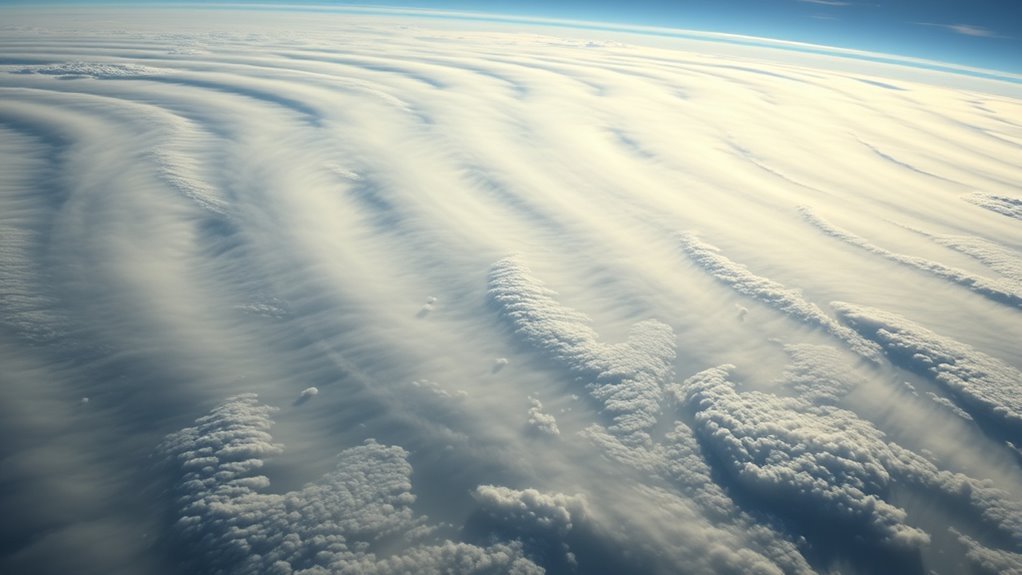
You’ll see how the Hadley, Ferrel, and Polar cells create distinct wind belts that move air from west to east across the globe.
These circulation cells form because of pressure zones that push air up or down, shaping the trade winds, westerlies, and easterlies.
Understanding these patterns helps you grasp how weather systems travel and change around the world.
Hadley, Ferrel, Polar
The Hadley, Ferrel, and Polar cells drive the major wind patterns that shape our weather across the globe.
In the Northern Hemisphere, the Hadley cell moves warm air from the equator toward 30° latitude, creating trade winds that blow from east to west near the equator.
Between 30° and 60°, the Ferrel cell generates westerly winds that flow from west to east, dominating the mid-latitudes.
These westerly winds play a key role in moving weather systems across much of North America and Europe.
Closer to the poles, the Polar cell circulates cold air toward 60°, producing polar easterlies that blow from east to west.
Together, these cells and their winds explain why much of the Northern Hemisphere experiences weather moving chiefly from west to east.
Wind Belts Formation
When Earth spins, it sets three main atmospheric circulation cells—Hadley, Ferrel, and Polar—into motion, creating distinct wind belts around the globe.
These cells drive prevailing winds that shape weather patterns.
Near the equator, the Hadley cell produces trade winds blowing from east to west, carrying warm air toward the tropics.
In the mid-latitudes, the Ferrel cell generates westerlies, while the Polar cell creates polar easterlies.
Thanks to the Coriolis Effect, these winds deflect to the right in the Northern Hemisphere.
This steering action influences surface winds and weather systems, causing them to move from west to east.
This interaction within the global atmospheric circulation results in consistent weather movement.
You can see this across regions like North America, all driven by the dynamic winds belt created by Earth’s rotation.
Pressure Zones Role
Understanding pressure zones helps you see how global atmospheric circulation cells control wind patterns and weather movement.
The Hadley, Ferrel, and Polar cells create distinct pressure zones at specific latitudes—low pressure at the equator from warm rising air, and high pressure in subtropical areas due to sinking cold air.
These pressure zones drive surface winds from high to low pressure.
However, the Coriolis effect, caused by Earth’s rotation, deflects these winds, shaping prevailing wind patterns.
In the mid-latitudes, this interaction causes weather systems to move primarily west to east.
Prevailing Westerly Winds in Mid-Latitudes

You’ll notice that the Coriolis effect plays a key role in steering winds from west to east in the mid-latitudes.
These prevailing westerly wind belts, found between 30 and 60 degrees latitude, are powerful drivers of weather patterns.
Plus, the jet stream within these winds acts like a fast-moving river of air, guiding storms and systems along their path.
Coriolis Effect Influence
Because the Coriolis effect causes air masses in the Northern Hemisphere to deflect to the right, you see prevailing westerly winds dominating the mid-latitudes.
This deflection influences the movement of winds, steering weather systems from west to east across vast regions like the United States.
The Coriolis effect strengthens with latitude, so these westerly winds are particularly powerful in mid-latitudes.
You can also observe its impact in the jet stream, a fast-moving current high in the atmosphere that flows west to east.
As seasons change, the strength and position of these winds shift, altering storm paths and weather patterns.
Understanding how the Coriolis effect shapes wind movement helps explain why weather generally travels west to east in your hemisphere.
Mid-Latitude Wind Belts
When air moves from high-pressure zones near 30 degrees latitude toward the poles, the Coriolis effect bends these winds eastward.
This creates the prevailing westerlies you experience in the mid-latitudes. These westerlies flow from west to east because of Earth’s rotation, shaping how weather systems travel across continents.
At altitudes between 20,000 and 40,000 feet, the jet stream strengthens these winds. It guides the movement of storms and fronts.
You can think of the mid-latitude wind belts as:
- Winds driven eastward by Earth’s rotation and the Coriolis effect.
- Strongest where the jet stream flows, influencing upper-level weather patterns.
- Movers of weather systems, affecting regions like North America and Europe.
Understanding these westerlies helps you see why weather often moves west to east in your area.
Jet Stream Guidance
How does the jet stream steer weather across vast distances?
The jet stream is a powerful high-altitude air current flowing from west to east in the mid-latitudes, usually between 20,000 and 40,000 feet.
You’ll notice it acts like a fast-moving river of air, guiding weather systems along its path.
Because its core can reach speeds over 200 miles per hour, the jet stream strongly influences how and where storms and fronts travel.
Seasonal shifts in its position, driven by temperature differences between polar and tropical air masses, mean it moves south in winter and north in summer.
This dynamic jet stream guarantees most weather systems follow a west to east trajectory, shaping the weather patterns you experience daily.
Role of the Jet Stream in Weather Movement
Although you might not see it, the jet stream plays a crucial role in moving weather systems from west to east across the Northern Hemisphere.
This high-altitude, fast-moving band of westerly winds guides weather systems along its path, influencing how they travel.
The jet stream forms where cold polar air meets warm tropical air, creating strong winds that blow mainly from west to east.
Here’s how it works:
- The jet stream acts as a conveyor belt, steering weather systems across continents.
- Its powerful winds accelerate storms, making them move faster from west to east.
- Changes in the jet stream’s position can shift weather patterns, affecting regional climate.
Cyclonic Systems and Their Direction of Rotation
Since the Coriolis effect influences wind direction, cyclonic systems in the Northern Hemisphere rotate counterclockwise.
In the Northern Hemisphere, the Coriolis effect causes cyclones to spin counterclockwise.
This cyclone rotation happens because the Coriolis force deflects inward-moving winds around low-pressure areas to the right.
As a result, the storm’s structure, including its eye, forms due to this rotation.
You’ll notice these cyclones generally drift from west to east across mid-latitudes.
That’s because prevailing westerlies push weather systems to move in that direction.
So, while the Coriolis force determines the spin of cyclones, the prevailing westerlies guide their overall movement.
Understanding this link helps you see why storms rarely travel north-south but follow a mostly west-to-east path across the Northern Hemisphere.
Interaction Between Warm and Cold Air Masses
The movement of cyclonic systems from west to east sets the stage for interactions between warm and cold air masses.
As you observe these air masses, you’ll notice they create distinct pressure zones that influence weather patterns.
Here’s what happens:
- Warm air rises near the equator, forming low-pressure areas due to intense solar heating.
- Cold air sinks at higher latitudes, creating high-pressure zones that push surrounding air masses.
- When warm air meets cold air, their temperature contrast drives storms and weather changes.
You’ll see that prevailing winds carry these air masses west to east.
So, the pressure differences and their interactions shape the weather you experience daily.
Understanding how warm and cold air masses interact helps explain the dynamic shifts in your local weather.
Influence of Topography on Weather Patterns
When you travel through mountainous regions, you’ll notice how the terrain shapes the weather in surprising ways.
The topography of mountains forces airflow upward, causing clouds and orographic rainfall on windward slopes.
On the leeward side, you’ll find drier conditions due to the rain shadow effect.
Valleys and mountain passes funnel wind, speeding it up and creating turbulence that can make weather more unpredictable.
At night, katabatic winds—cold, downslope winds—flow from elevated slopes, influencing local temperatures and wind patterns.
The shape of the terrain also creates turbulence and eddies near ridges and steep slopes, affecting both weather distribution and aviation.
Understanding how mountains shape airflow helps you see why weather doesn’t just move east but interacts dynamically with topography.
Seasonal Shifts in Wind and Weather Patterns
As seasons change, you’ll notice the jet stream shifting north in summer and south in winter. This dramatically alters weather patterns.
This polar jet stream movement is a key factor in seasonal shifts, influenced by Earth’s rotation and the resulting winds in the Northern Hemisphere. Here’s what happens:
- In winter, the polar jet stream dips south, pulling cold air and storm systems into lower latitudes.
- During summer, it moves north, bringing warmer, more stable conditions to many areas.
- These shifts change the location and strength of pressure systems, creating distinct wet and dry seasons.
Understanding these seasonal shifts helps you see why weather moves west to east.
It also explains why patterns vary throughout the year.
Impact of Ocean Currents on Regional Weather
You’ve seen how shifting jet streams steer weather patterns across continents, but ocean currents also play a powerful role in shaping regional climates.
Ocean currents like the Gulf Stream transport warm water from the tropics toward the North Atlantic, warming nearby regions. These currents are driven by wind patterns, Earth’s rotation, and differences in temperature and salinity.
Warm ocean currents influence the development and intensification of weather systems, including hurricanes that move west to east. They also affect temperature, humidity, and precipitation along coastlines.
This moderates climates in northeastern North America and northwestern Europe. By redistributing heat, ocean currents shape your local weather.
They’re a vital factor behind the movement and character of regional weather systems you experience every day.
Frequently Asked Questions
Which Wind Direction Is the Coldest?
The coldest wind direction is usually from the north or northeast if you’re in the Northern Hemisphere.
In the Southern Hemisphere, it’s from the south or southeast.
These winds carry cold polar air that chills your surroundings.
Does Wind Ever Go East to West?
Yes, wind can go east to west, especially near the equator where trade winds blow that way.
You’ll also notice this in mountain valleys or during certain weather events.
Despite most winds moving west to east, there are exceptions!
What Is the Wind Blowing From West to East Called?
The wind blowing from west to east is called the prevailing westerlies.
You’ll notice these winds dominate mid-latitudes, guiding storms and weather systems eastward.
Especially during winter, temperature differences intensify their strength.
Why Do Tornadoes Move From West to East?
Tornadoes dance eastward because the jet stream acts like an invisible river pushing them along.
You’ll find they follow this swift, high-altitude wind, steering their wild spin from west to east across the sky.
Conclusion
You can think of weather as a river flowing across the sky, driven by Earth’s spin and the Coriolis Effect.
Because of these forces, prevailing winds push weather systems from west to east, especially in mid-latitudes.
The jet stream acts like a fast-moving current, guiding storms along their path.
So next time you check the forecast, remember: the atmosphere’s dance, shaped by rotation and winds, keeps weather moving steadily eastward.
In conclusion, the interplay of Earth’s rotation and the Coriolis Effect creates a dynamic system that moves weather predominantly from west to east.
By understanding the role of the jet stream and prevailing winds, we gain insight into weather patterns that influence our daily lives.
So, whether you’re planning a trip or just curious about the weather, keep in mind that these forces are constantly at work, shaping the atmosphere and our weather experiences.