Which Weather Models Are the 5 Most Accurate?
If you want the most accurate weather forecasts, you’ll rely on five key weather models. Each of these models excels in different areas, making them invaluable for various forecasting needs.
ECMWF’s IFS leads globally for medium-range forecasts with a detailed 14 km resolution.
On the other hand, HRRR dominates short-term US predictions, providing radar-updated storm information.
The AI-enhanced ECMWF AIFS boosts accuracy and speed for extended forecasting, making it a powerful tool for long-term predictions.
Meanwhile, the UK Met Office model excels over the Atlantic, offering precise storm tracking capabilities.
Lastly, NOAA’s GFS provides free global forecasts that extend up to 16 days, ensuring you stay informed no matter where you are.
Each model has its strengths, and there’s much more to uncover about what makes them stand out in the world of weather forecasting.
ECMWF IFS: Leading Global Model Accuracy
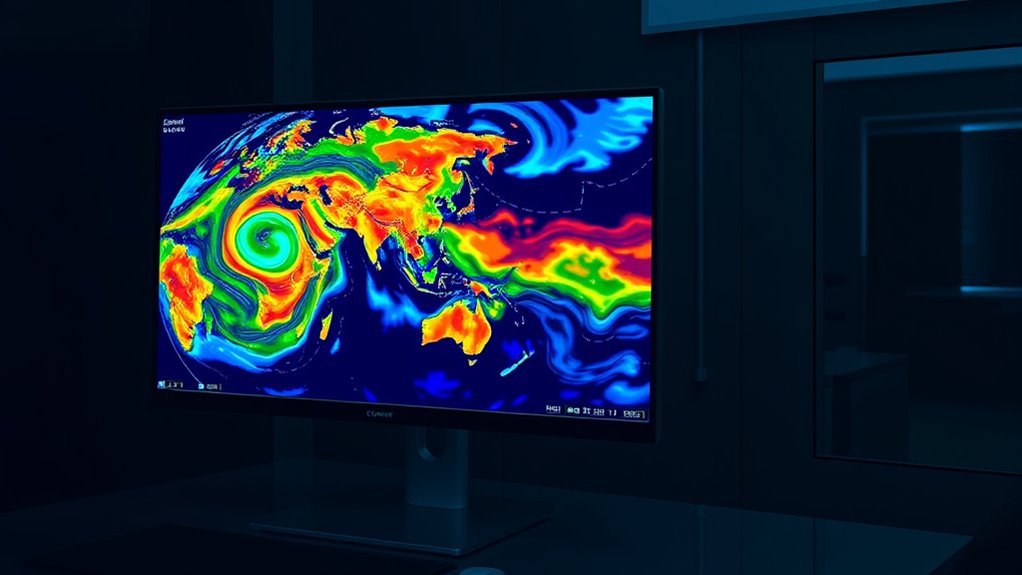
Although many weather models compete globally, the ECMWF IFS stands out as the most accurate for medium-range forecasts up to 10 days.
You’ll find that this global weather model consistently achieves top anomaly correlation scores, proving its superior forecast accuracy.
Thanks to its high spatial resolution of about 14 km, the ECMWF IFS delivers detailed weather predictions you can trust.
It focuses on predicting large-scale weather patterns, including cyclones, with impressive precision.
Supported by 34 European nations, the model updates twice daily but still leads thanks to advanced data assimilation techniques that integrate vast observational data efficiently.
When you rely on ECMWF, you’re tapping into a sophisticated system designed specifically for reliable medium-range forecasts, making it the go-to choice for accurate global weather prediction.
HRRR: Top Choice for US Short-Term Forecasts
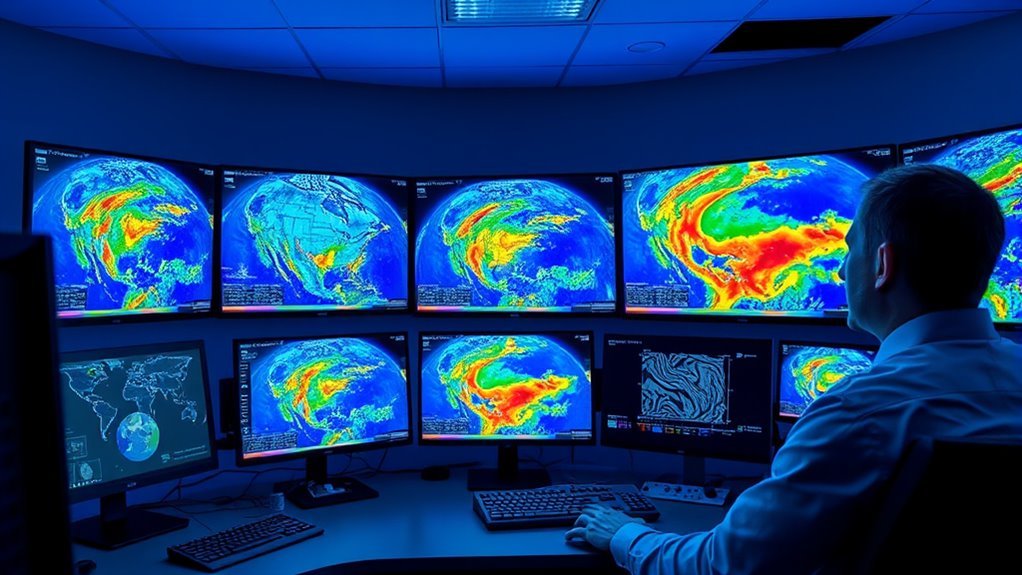
While the ECMWF IFS excels at medium-range global forecasts, the HRRR model takes the lead for short-term weather predictions across the US.
You’ll find HRRR indispensable for its high-resolution, 3 km grid and hourly updates. This makes it perfect for precise US weather models focused on real-time updates.
Its ability to ingest radar data every 15 minutes lets you track storm development and severe weather like thunderstorms, hail, and tornadoes within an 18-hour window.
HRRR’s quick refresh rate guarantees accurate hurricane tracking and timely weather prediction, especially in rapidly changing conditions.
- High-resolution 3 km grid for detailed short-term forecasts
- Radar data ingestion every 15 minutes
- Excels in severe weather and storm development tracking
- Provides real-time updates for aviation and emergency services
- Outperforms global models for US-specific short-term weather
AI-Enhanced ECMWF AIFS Model Performance

Since its launch in February 2025, the AI-enhanced ECMWF AIFS model has transformed weather forecasting by delivering 15-day predictions with a 28 km resolution.
This model excels in capturing large-scale patterns and improves forecast accuracy by about 10% over previous approaches.
Its AI-driven meteorology enables faster runs—nearly 1,000 times quicker—supporting rapid ensemble forecasting and detailed probabilistic weather analysis.
You’ll find it especially reliable for medium-range forecasts and cyclone prediction, boasting 20% better performance on tropical cyclones.
However, the ECMWF AIFS model’s coarser resolution limits its precision for extreme precipitation and localized severe weather.
Still, as one of the leading AI-enhanced weather models, it reshapes how you interpret large-scale atmospheric phenomena and probabilistic outcomes in modern forecasting.
UK Met Office Unified Model for Atlantic Weather
How does the UK Met Office Unified Model stand out in forecasting Atlantic and European weather?
You get a regional weather model that excels in storm prediction and high-resolution forecasting, especially for Atlantic weather.
The UK Met Office unified model operates globally at about 10 km resolution but sharpens to 1.5 km with UKV nests over the UK.
This boost in resolution significantly enhances weather accuracy for European weather patterns and Atlantic storms.
It provides detailed 7-day forecasts, making it invaluable for tracking severe weather events.
- High-resolution UKV nests at 1.5 km
- Accurate Atlantic storms and European weather patterns
- Strong regional focus on maritime conditions
- Ranked second globally in weather accuracy after ECMWF
- 7-day forecast range ideal for medium-term planning
NOAA GFS: Most Accessible Free Global Model
Because it’s fully free and publicly accessible, the NOAA GFS (Global Forecast System) stands out as the go-to global weather model for many users worldwide.
Fully free and publicly accessible, NOAA GFS is the preferred global weather model for users worldwide.
This free weather model offers global forecasts up to 16 days ahead, making it invaluable for extended outlooks.
While its model resolution of about 13 kilometers is lower than some high-precision alternatives, the GFS provides timely updates four times daily, supporting reliable weather prediction and tracking of rapidly changing conditions.
Its forecast accuracy may not top premium models, but its worldwide accessibility and exhaustive coverage make it a cornerstone for research, general forecasting, and cross-checking.
If you need a publicly available global weather model that balances accessibility with solid forecast accuracy, NOAA GFS is your best bet.
Frequently Asked Questions
Is GFS or ECMWF More Accurate?
You’ll find ECMWF more accurate for medium-range forecasts due to its higher resolution and consistent skill.
However, GFS can sometimes better predict specific severe events like hurricanes.
Choose based on your forecast needs.
Which Weather Model Is the Most Accurate?
You’ll find the ECMWF model is the most accurate for medium-range forecasts because it uses finer resolution and advanced techniques.
For short-term, localized predictions, models like HRRR perform better at capturing severe weather events.
Is Noaa or Accuweather More Accurate?
You’ll find NOAA more accurate for broad, medium-range forecasts,
while AccuWeather often nails short-term, local predictions by blending multiple models and local data.
It depends on your forecast needs and timeframe.
Is Hrrr or Nam More Accurate?
You’ll find HRRR more accurate for short-term, localized forecasts because it updates hourly with higher resolution.
NAM covers broader areas and longer timeframes but isn’t as precise for immediate, detailed weather changes.
Conclusion
You might think all weather models are equally unreliable, but these five prove otherwise.
The ECMWF IFS leads globally in accuracy, while the HRRR excels in short-term US forecasts.
The AI-enhanced ECMWF AIFS boosts precision even more. The UK Met Office model shines for Atlantic weather, and NOAA GFS offers accessible, dependable global data.
Trusting these top models means you’re getting the best forecast science available today—no guesswork needed.
In conclusion, while weather forecasting can sometimes feel like a gamble, relying on these five models can significantly improve your odds. The ECMWF IFS, HRRR, AIFS, UK Met Office, and NOAA GFS stand out for their accuracy and reliability.
By using these trusted sources, you can stay informed about upcoming weather patterns and make better decisions for your day-to-day activities. So, whether it’s for planning a trip or just knowing how to dress for the day, these models have you covered!