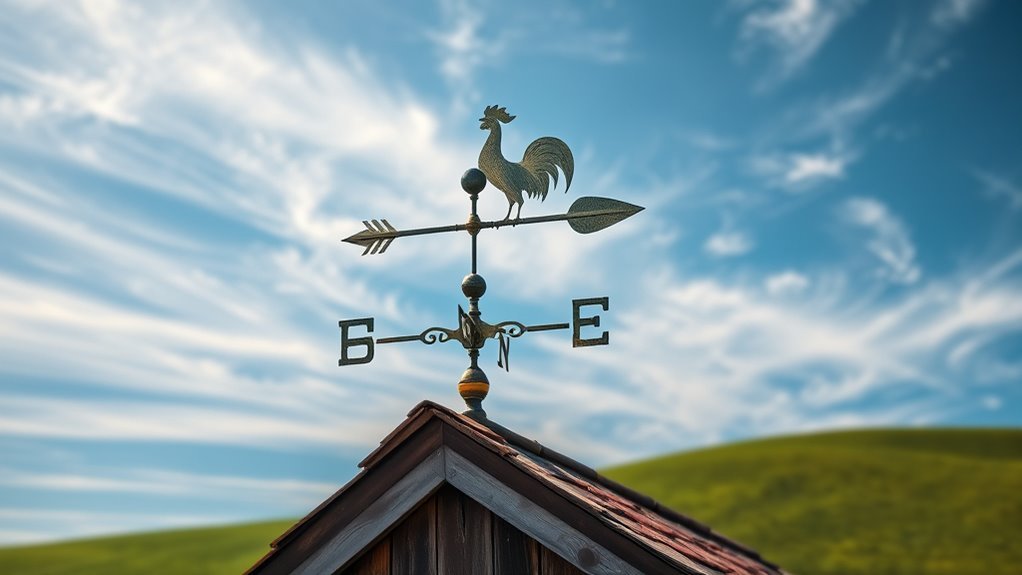
How Does a Weather Vane Work?
You can tell wind direction by watching a weather vane’s arrow pivot freely on a vertical axis.
When the wind blows, it pushes the vane’s larger tail, creating pressure that turns it until the arrow points into the wind’s source.
Mounted high and balanced carefully, it responds quickly and precisely.
Modern versions add sensors for accuracy and durability.
If you want to understand how placement, design, and technology affect performance, keep exploring.
The Basic Components of a Weather Vane
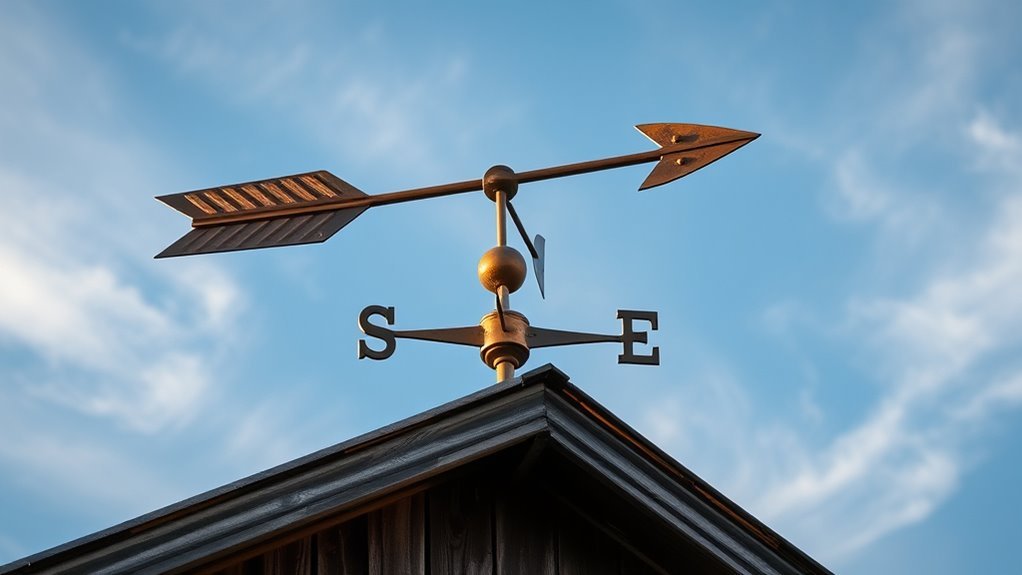
Although you might only notice the decorative arrow or ornament, a weather vane relies on several key components to function properly.
At its core, the wind vane includes an arrow or ornament mounted on a horizontal rod that rotates freely around a vertical axis. This setup allows the vane to pivot when the wind blows.
Fixed directional indicators—N, S, E, and W—stay stationary, providing a reference point for the direction of the wind.
The arrow is cleverly designed with a larger surface area at the tail to catch the wind, causing the entire wind vane to turn and point into the wind’s source.
Usually mounted on a shaft or spire, the elevated position guarantees an accurate reading of wind direction.
How Wind Direction Influences the Vane
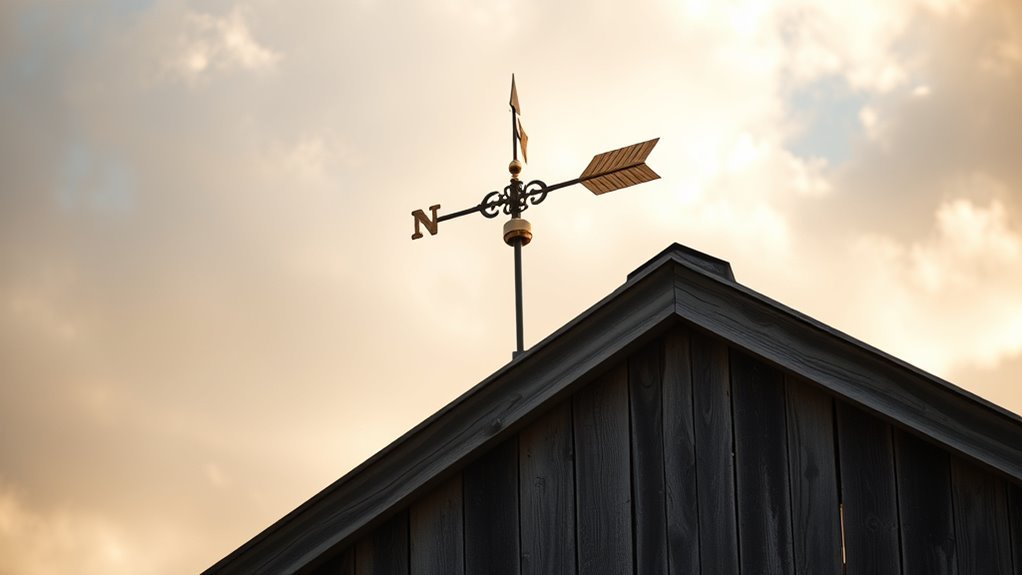
When wind hits the weather vane, it pushes the tail, causing the vane to turn and align with the wind’s direction.
You’ll notice the arrow always points toward where the wind is coming from, thanks to this interaction.
Using the fixed directional markers, you can easily interpret the exact wind direction based on the vane’s position.
Wind Interaction Mechanics
How exactly does the wind guide a weather vane’s movement?
When the wind blows, it interacts directly with the vane, causing it to rotate and align itself with the wind’s direction.
Here’s how this interaction works:
- The wind pushes against the vane’s tail, which is designed to catch the airflow and create pressure.
- This pressure causes the vane to pivot freely around its central axis, thanks to a balanced pivot point.
- The arrow-shaped front of the vane points into the wind, showing where the wind originates.
Because of its aerodynamic shape, the vane responds quickly and accurately to changing wind directions.
This helps you easily identify wind patterns by simply observing its movement.
Directional Indication Process
Because the wind’s direction determines the weather vane’s position, you can easily tell where the breeze originates by watching the arrow.
Wind vanes have a larger tail fin and a pointed front. When the wind blows, it pushes against the tail fin, causing the arrow to rotate.
This rotation aligns the arrow to point into the wind’s source. The directional markers on the vane stay fixed, while the arrow moves freely.
Thanks to its aerodynamic shape, the vane responds accurately even to gentle breezes. It consistently faces opposite the wind’s flow.
The Physics Behind Weather Vane Movement
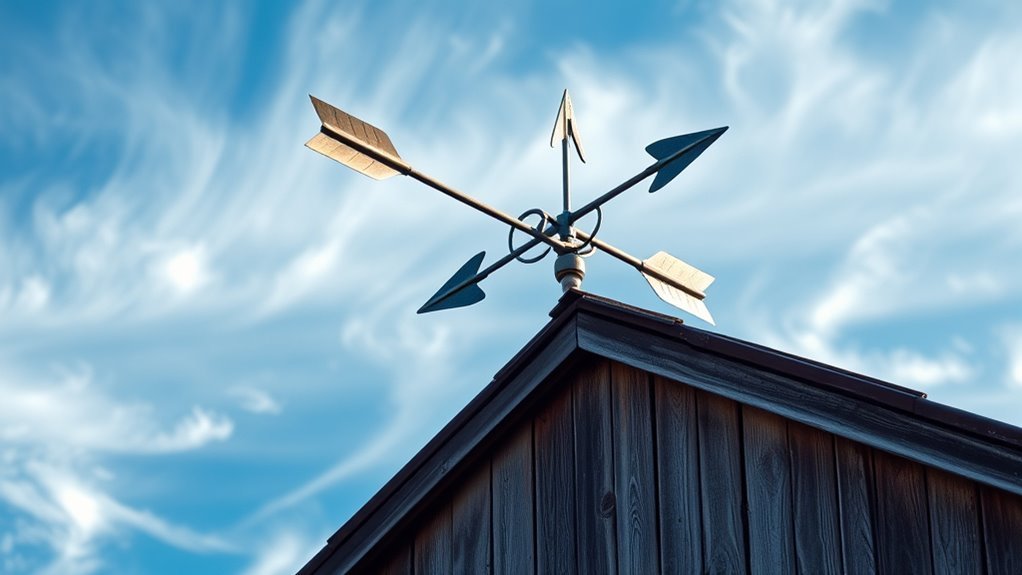
You’ll notice the weather vane turns because wind force creates torque around its pivot point.
Its balanced design and smooth pivot let it rotate freely, while the aerodynamic shape reduces resistance and helps it align accurately.
Understanding these principles shows how the vane reliably points into the wind.
Wind Force and Torque
When wind hits a weather vane, it pushes against both the arrow and the tail, creating a force that makes the vane spin around its pivot.
This wind force generates torque, which is the twisting effect causing rotation.
Here’s how it works:
- The larger surface area of the tail catches more wind, producing greater drag and torque.
- Torque overcomes friction at the pivot, allowing the vane to rotate smoothly.
- The vane spins until the arrow points into the wind, balancing the torque from wind force.
As wind speed changes, the amount of torque shifts, prompting the vane to adjust and show the current wind direction.
Your weather vane’s movement directly results from this dynamic interaction between wind force and torque.
Balance and Pivot Mechanics
The torque generated by wind force acts on the weather vane’s pivot, a horizontal axis that lets the vane spin freely.
This pivot, often made of smooth brass or steel, minimizes friction to guarantee the vane moves effortlessly.
You’ll notice the vane’s design balances aerodynamic forces: a larger tail and pointed front create a natural imbalance that guides its rotation.
When wind hits the vane, pressure differences between the tail and arrow cause it to turn around the pivot until it finds equilibrium.
At this balanced position, the arrow aligns with the wind’s source, showing you where the wind is coming from.
Understanding the pivot and balance mechanics reveals how weather vanes respond so precisely to changing wind directions.
Aerodynamic Shape Effects
Although you might not notice it, the aerodynamic shape of a weather vane plays a crucial role in how it moves.
This shape allows air to flow smoothly around the vane, reducing resistance and enabling it to respond accurately to wind direction.
Here’s how it works:
- The larger tail fin creates pressure differences on each side, causing the vane to pivot toward the wind source.
- Wind pushes against the vane’s surfaces, rotating it until the pointed end faces the wind’s origin.
- Faster airflow over the vane lowers pressure on one side, guiding alignment based on Bernoulli’s principle.
Thanks to its aerodynamic shape, the weather vane reacts sensitively even to gentle breezes.
That means you get precise wind direction readings every time.
Historical Origins of Weather Vanes
How did people first figure out how to track the wind’s direction?
They created early weather vanes, some of the oldest found on the Tower of the Winds in Athens around 50 BC.
These bronze wind deities showed the wind’s direction clearly.
Weather vanes actually date back over two thousand years, with ancient Greece and Rome leading the way.
Meanwhile, ancient China used wind-observing fans and bird-shaped vanes by 139 BC to predict weather.
Vikings mounted weather vanes on their ship masts to navigate effectively.
By the 9th century, medieval European churches adopted weather vanes, often crafting them as roosters for practical use.
Each innovation helped people better understand and respond to changing wind conditions long before modern technology existed.
Symbolism and Cultural Significance
Beyond their practical use, weather vanes have carried rich symbolic meanings across cultures and centuries.
Weather vanes embody centuries of cultural symbolism beyond their practical purpose.
When you look at a weather vane, you’re not just seeing a tool; you’re witnessing a symbol steeped in spiritual significance and cultural identity.
1. The rooster weather vane, popularized by Pope Gregory I, reminds you of vigilance and faith.
It links to Saint Peter’s story of betrayal and repentance.
2. In many cultures, weather vanes sit atop sacred buildings.
They are believed to offer protection and divine oversight.
3. Ancient designs, like Viking weather vanes, showcase cultural artistry.
They also serve as spiritual symbols that watch over communities.
Variations in Weather Vane Designs
When you spot a weather vane, you’ll notice a wide range of designs—from simple arrows to intricate roosters, ships, and mythical creatures.
Weather vanes come in diverse styles reflecting cultural and artistic preferences. Some designs are functional and minimalist, while others are decorative, made from copper, iron, or aluminum.
Here’s a quick look at popular weather vane designs:
| Design Type | Material | Typical Use |
|---|---|---|
| Arrow | Iron, Aluminum | Simple direction indicator |
| Rooster | Copper | Traditional, symbolic |
| Ship | Iron, Copper | Nautical themes |
| Mythical | Various Metals | Artistic, cultural motifs |
| Animals | Mixed Metals | Personalized or thematic |
These weather vane designs often match a building’s style or the owner’s interests.
It shows how versatile and meaningful they can be.
Modern Technological Enhancements
Although traditional weather vanes have a timeless charm, modern technological enhancements have transformed them into precise instruments.
You’ll find that today’s weather vanes combine classic design with cutting-edge technology to measure wind direction more accurately and efficiently.
Here are three key advancements:
- High-precision sensors detect subtle changes in wind direction, even at low speeds. This improves accuracy beyond the traditional vane’s capabilities.
- Wireless transmission technology sends real-time wind direction data to remote displays or monitoring stations. This lets you track conditions instantly.
- Integration with electronic anemometers allows simultaneous measurement of wind speed and direction. This offers exhaustive data in one device.
These improvements often come with durable materials and digital calibration features.
This ensures reliable, long-term performance in all weather conditions.
Ideal Placement for Accurate Readings
To get the most accurate readings from your weather vane, you need to install it at the right height and location.
Ideally, mount your weather vane about 30 feet above the ground to reduce obstructions that can interfere with wind direction.
Make sure it’s placed over level terrain, away from buildings, trees, or other obstacles that cause turbulence or false wind patterns.
Keep your weather vane at least twice the height of nearby large objects to ensure smooth, consistent airflow.
Choose a sturdy, unobstructed spot like a rooftop or spire to secure the weather vane firmly.
Practical Uses of Weather Vane Data
Once your weather vane is properly placed for accurate readings, you can start using its data in practical ways.
Measuring wind and tracking wind direction helps you make informed decisions in various fields.
Tracking wind direction provides essential insights for smarter decisions across diverse industries and activities.
Here are three key uses:
- Farmers and sailors rely on wind direction to plan activities and prepare for storms, optimizing safety and productivity.
- Weather forecasters integrate wind vane data into models to predict pressure systems, improving weather accuracy.
- Aviation and construction industries use wind direction info for safety protocols, ensuring operations adapt to changing conditions.
Frequently Asked Questions
Do Weathervanes Really Work?
Yes, weathervanes really work.
If you place them high and clear of obstructions, they’ll accurately show wind direction by turning to face the wind’s origin.
Just make sure it’s properly installed and maintained.
How Do You Read a Weather Vane?
Reading a weather vane is like reading a compass; just watch which direction the arrow points.
If it points north, the wind’s coming from there.
Check the letters (N, S, E, W) to know the wind’s origin.
How Do Weather Vanes Work?
You’ll see the weather vane spin on its axis as the wind pushes its tail,
making the arrow point to where the wind’s coming from.
Its balanced design helps you read even light breezes accurately.
What Causes a Weathervane to Turn Into the Wind?
You’d think a weather vane dances like a magician’s wand, but it’s actually the wind pushing its big tail that makes it spin.
That pressure forces it to turn, pointing you right where the wind’s coming from.
Conclusion
Think of a weather vane as a wise old storyteller, always turning to face the winds of change.
Just like you adjust your sails when the tides shift, the vane points you toward nature’s whispers, guiding your understanding of the skies.
By reading its silent dance, you connect with centuries of knowledge, blending tradition with today’s tech.
So next time you watch it spin, remember—it’s not just metal; it’s a compass for your curiosity.
Weather vanes are fascinating tools that show us which way the wind is blowing. They’ve been around for centuries, serving as both functional instruments and beautiful decorations.
In the end, a weather vane is more than just an object; it’s a bridge between the past and present, enhancing our appreciation for meteorology. So, next time you see one, think of it as a guide to understanding the weather and the stories it tells.