What Does Concrete Cure in Cold Weather Do?
When you cure concrete in cold weather, you’re essentially protecting its strength and preventing any damage from freezing temperatures. Proper curing is crucial as it keeps the concrete warm and moist, allowing hydration to continue and avoiding those pesky internal cracks or reduced durability.
To achieve this, you need to maintain temperatures above 40–50°F for several days. You can do this using insulation, heaters, or protective covers.
Without these protective measures, your concrete is at risk of early failure, which can be a costly setback. So, keep your project on track by employing smart protection techniques and tools that ensure quality results, even in colder conditions.
Remember, taking the time to properly cure your concrete can make all the difference in its long-term performance and durability!
Why Proper Curing Is Critical in Cold Weather
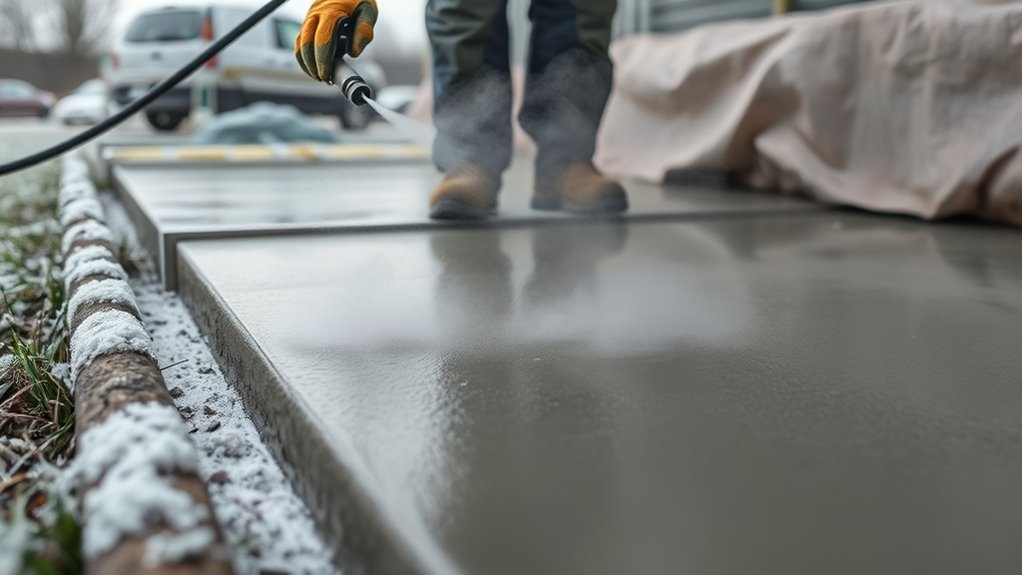
Although curing concrete in cold weather can be challenging, you must maintain adequate moisture and temperature to make certain it reaches its designed strength.
Cold-weather curing is essential because low temperatures can stop hydration, which is the chemical reaction that allows concrete to harden and gain strength.
Without this process, your concrete remains weak and porous, increasing the risk of damage.
To support proper strength development, you need to keep the concrete temperature above 50°F for at least 3 to 7 days.
Using insulation helps retain heat and moisture, preventing premature drying and surface cracking.
The Impact of Freezing on Fresh Concrete
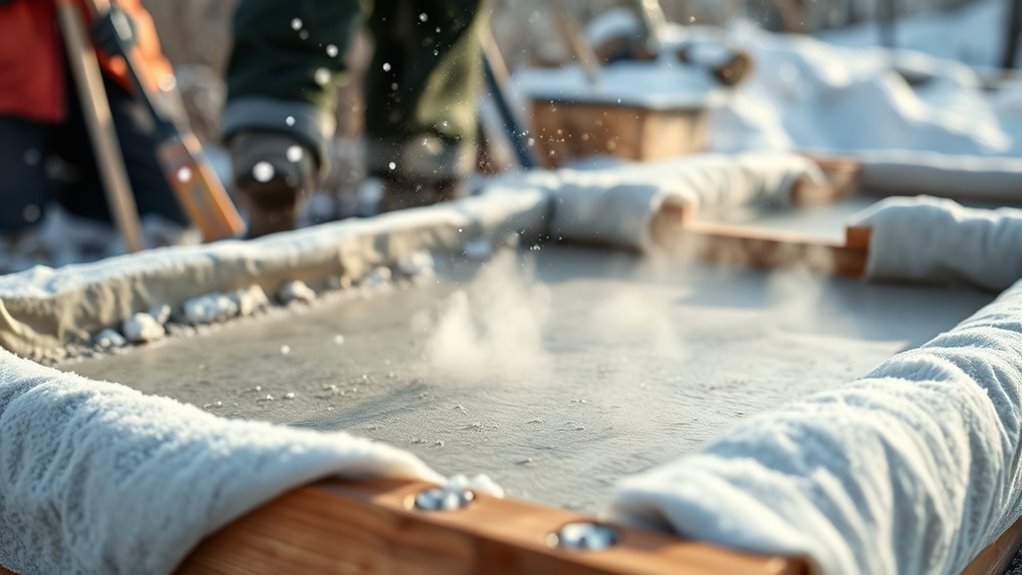
You need to understand that freezing fresh concrete can cause serious damage by disrupting the hydration process vital for strength.
Early freezing stops cement particles from bonding, which can slash the concrete’s compressive capacity by up to half.
Once this damage happens, no amount of warming or curing can fully restore its original strength.
Freezing Effects on Strength
When fresh concrete freezes before it cures, it suffers immediate and lasting damage that cuts its strength substantially.
Freezing water inside the concrete mix forms ice crystals, causing internal cracking and micro-voids.
This damage disrupts the curing process, halting hydration and preventing the concrete from reaching its full strength potential.
If freezing occurs during early curing stages, the concrete can lose up to 50% of its compressive strength, even if it’s later warmed and cured properly.
Because the curing process is critical for strength development, any interruption from freezing permanently weakens the concrete’s structure.
To guarantee durable and strong concrete, you must protect it from freezing temperatures during curing.
Using cold-weather curing methods is essential to maintain proper hydration and avoid strength loss.
Early Freeze Damage
If fresh concrete freezes during its early curing phase, it suffers immediate and irreversible damage that compromises its strength.
This early freeze damage occurs because freezing concrete halts the hydration process—the chemical reactions that develop strength in the mix.
When water inside the concrete freezes at temperatures around 25-27°F, it stops these essential reactions, preventing proper concrete curing.
As a result, the concrete can lose up to 50% of its potential compressive strength.
You’ll notice cracking, scaling, and surface defects forming when the concrete freezes too soon, weakening the overall structure.
Unfortunately, once this damage happens, warming the concrete later won’t fix it.
To avoid early freeze damage, you need to protect fresh concrete from freezing during the critical initial curing period.
Hydration Disruption Risks
Freezing fresh concrete doesn’t just pause its curing—it disrupts the entire hydration process that binds the cement matrix.
When you deal with cold weather concrete, freezing concrete early causes hydration disruption that halts chemical bonding, damaging strength and durability.
Here’s what you need to watch out for:
- Water inside concrete freezes, stopping the curing process abruptly.
- Expansion of ice causes micro-cracks in the cement matrix.
- Concrete may lose up to 50% of its compressive strength if frozen too soon.
- Hydration can’t effectively restart once disrupted by freezing.
- Surface scaling and cracking risks increase due to interrupted curing.
To guarantee your cold weather concrete cures properly, preventing freezing during early stages is vital for maintaining long-term structural integrity.
Recommended Temperature Ranges for Cold Weather Curing
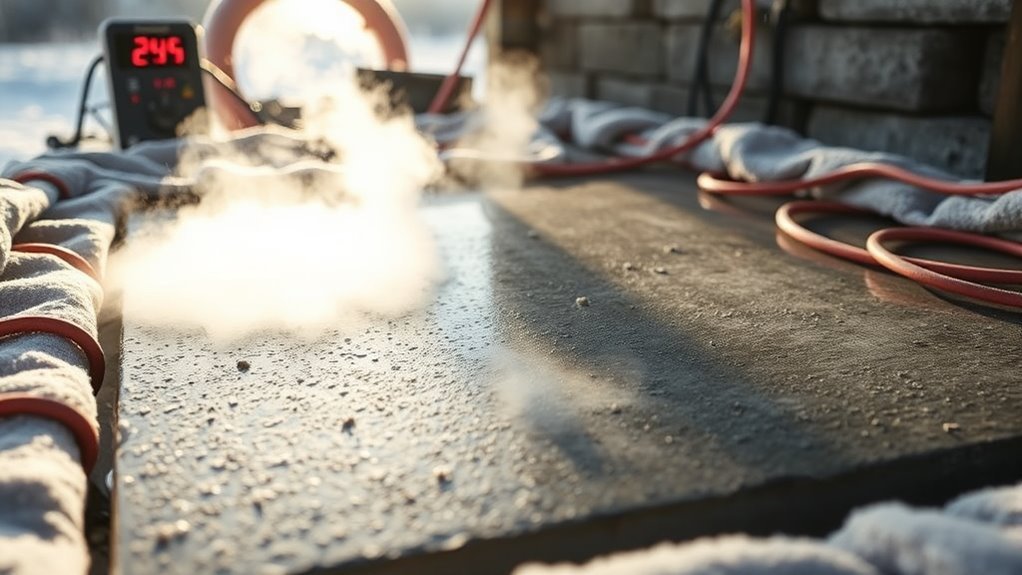
Although cold weather poses challenges for concrete curing, maintaining proper temperature ranges is crucial to guarantee strength development.
You should keep the concrete temperature above 40°F (4°C) for at least 72 hours to ensure proper curing.
For thick concrete—over 25 inches—curing temperatures need to stay above 50°F (10°C) to prevent freezing and support hydration.
Ideally, cold-weather concrete cures best between 50°F and 70°F (10°C to 21°C).
If temperatures drop below 50°F, use insulated blankets or other protective measures to maintain these curing temperatures.
Remember, hydration slows down in colder conditions, so you might need to extend curing times beyond 7 days to achieve the desired strength.
Keeping these temperature guidelines ensures your concrete cures properly even in cold weather.
Techniques to Protect Concrete From Freezing Temperatures
When temperatures plunge below freezing, you need to take specific measures to safeguard your concrete and guarantee proper curing.
Protecting your curing concrete from freezing involves controlling the temperature and preventing heat loss. Here are effective techniques to keep your concrete safe:
- Use insulating blankets to retain heat and shield concrete from cold air.
- Employ weatherproof enclosures with heaters to create a controlled curing environment.
- Seal forms properly and install windbreaks to reduce heat escape.
- Apply additional curing membranes or water to maintain moisture and provide thermal protection.
- Consider hydronic heating tubes to raise or maintain concrete temperature above freezing.
Tools and Equipment for Maintaining Heat During Curing
To maintain proper curing temperatures, you’ll need reliable tools and equipment designed to provide consistent heat and monitor conditions closely.
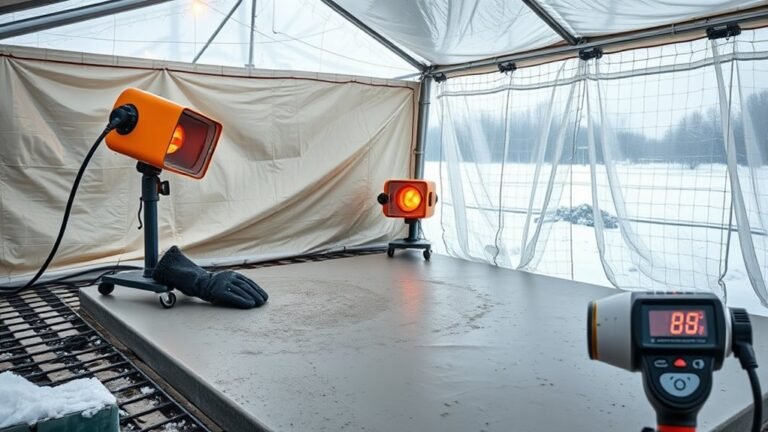
Heated enclosures, such as tents warmed by portable combustion or electric heaters, create a controlled environment around the concrete.
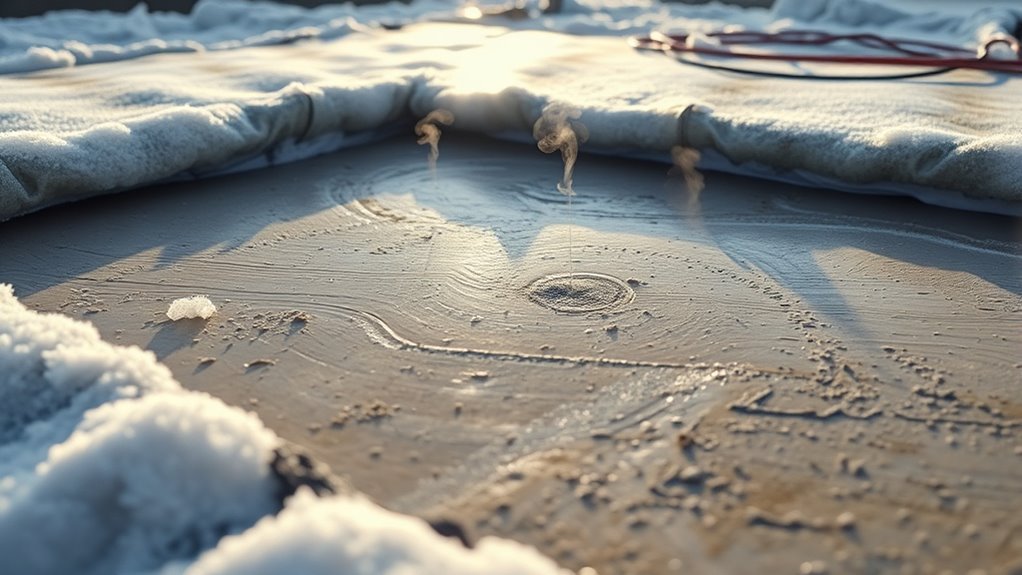
Heated hoses can be embedded in the subgrade or laid on the surface to deliver steady warmth directly where it’s needed.
Thermal covers, including insulated blankets and shrink wraps, help prevent heat loss by insulating the concrete surface.
You’ll also want to use temperature sensors to track conditions in real-time, ensuring the concrete stays within the ideal curing range.
These tools work together to create an effective system that protects your concrete from cold weather challenges and promotes proper strength development.
Monitoring Concrete Temperature and Strength Development
You’ll want to use temperature sensors like SmartRock® and infrared thermometers to keep a close eye on concrete’s temperature during curing.
For strength verification, maturity sensors and cylinder tests help confirm when the concrete reaches the proper strength.
Monitoring these factors guarantees you can take action before cold weather compromises your project.
Temperature Monitoring Tools
Although cold weather poses challenges for concrete curing, using temperature monitoring tools lets you track internal and surface temperatures accurately.
These tools provide essential data to ensure your concrete cures properly despite freezing conditions.
Maturity sensors, like SmartRock®, continuously record internal temperature, helping you assess curing progress effectively.
Infrared thermometers offer quick surface temperature checks to keep concrete above critical thresholds.
Real-time temperature monitoring enables timely adjustments to prevent freezing and optimize curing methods.
Key temperature monitoring tools include:
- Maturity sensors for internal temperature tracking
- Infrared thermometers for surface readings
- Data loggers for continuous monitoring
- Wireless systems for remote access
- Alerts for temperature threshold breaches
Using these tools improves your cold weather concrete curing results by guaranteeing accurate temperature data and better planning.
Strength Verification Methods
When curing concrete in cold weather, monitoring temperature and strength development is crucial for ensuring durability.
You can use maturity sensors like SmartRock® to track the internal temperature, which helps estimate in-place strength development throughout the curing period.
Temperature monitoring with infrared thermometers ensures the surface stays above critical thresholds, preventing cold damage.
To verify strength, compare real-time maturity data with calibrated lab cylinder tests. This confirms the concrete reaches the required strength before removing curing protections.
Remember, concrete must cure at temperatures above 50°F for at least seven days to achieve adequate strength in cold conditions.
Regular monitoring and strength verification prevent premature exposure, ensuring your concrete meets specifications and performs well over time.
Common Mistakes to Avoid in Cold Weather Concrete Work
If you don’t carefully monitor and control the concrete temperature during cold weather work, the mixture can freeze and stop curing. This can weaken the entire structure.
To protect concrete and ensure proper curing, avoid these common mistakes:
- Neglecting temperature control, which can lead to freezing and halted hydration.
- Applying insufficient insulation, leaving concrete exposed to damaging cold weather.
- Rushing finishing before bleed water evaporates, which can cause surface scaling.
- Using uncalibrated sensors that result in inaccurate temperature readings.
- Failing to plan for adequate curing time and temperature maintenance.
Taking these precautions can make a significant difference in the durability of your concrete work.
Planning and Cost Considerations for Winter Concrete Projects
Since cold weather construction demands extra heating, insulation, and protective measures, you can expect project costs to rise by 20-50%.
When planning winter construction projects, it’s essential to develop a thorough cold weather protection plan well before the concrete cure begins.
You’ll need to budget for heated enclosures, hydronic heaters, and special curing materials, which can markedly increase expenses.
Scheduling pours during warmer periods and ordering extra materials in advance helps keep your project on track despite weather challenges.
Coordinating equipment and personnel early reduces risks and delays.
Don’t forget to consult experts familiar with regional cold weather techniques; this investment can optimize costs and improve concrete durability.
Effective planning ensures your cold weather construction projects succeed without compromising quality or budget.
Best Practices for Ground Preparation Before Cold Weather Pouring
Proper ground preparation plays an essential role in guaranteeing successful concrete curing during cold weather.
You need to create a stable, thawed base to avoid issues like cracking or uneven settling.
Here are the best practices for ground preparation before pouring concrete in cold weather:
- Clear all snow, ice, and moisture from the ground thoroughly.
- Avoid pouring on frozen ground; thaw it first to prevent instability.
- Use blankets, heated mats, or black plastic to warm cold surfaces.
- Pre-warm the subgrade with hydronic or electric heaters to keep the temperature above 50°F (10°C).
- Use a thermometer to verify the ground and subbase temperature are suitable for curing.
Following these steps ensures the right temperature and stable base, which are critical for proper cold weather curing.
Using Technology to Enhance Cold Weather Concrete Curing
While curing concrete in cold weather presents unique challenges, using technology can substantially improve your results.
Temperature sensors like SmartRock® give you real-time concrete temperature data, so you can monitor internal conditions closely. Infrared thermometers let you quickly check surface temperature, ensuring it stays above critical levels.
Maturity meters help validate concrete strength development despite the cold, letting you adjust curing strategies efficiently.
| Technology | Purpose | Benefit |
|---|---|---|
| Temperature Sensors | Monitor internal concrete temperature | Prevent freezing, optimize cure |
| Infrared Thermometers | Measure surface temperature | Quick checks, maintain thresholds |
| Maturity Meters | Validate strength development | Data-driven adjustments |
| Continuous Monitoring | Real-time data | Energy-efficient, reliable cure |
Using these tools, you can ensure your concrete cures effectively, even in freezing conditions.
Frequently Asked Questions
Will Concrete Cure at 40 Degrees?
Yes, concrete will cure at 40 degrees, but you’ll notice it slows down markedly.
You’ll need to extend the curing time and use protective measures to guarantee proper strength and durability in colder conditions.
What Is the Minimum Temperature for Curing Concrete?
You need to keep concrete at a minimum of 50°F (10°C) for proper curing, especially during the first 48 hours.
Below 40°F (4°C), curing slows down a lot and can weaken your concrete’s strength.
So, it’s really important to monitor the temperature during the curing process.
Taking these precautions can help ensure your concrete cures effectively and remains strong.
Can I Pour Concrete if It Freezes at Night?
You can pour concrete if it freezes at night, but if it freezes within 24 hours, it can lose up to 50% of its strength.
To ensure the best results, use insulation or heaters to protect it during curing.
This way, you minimize the risk of the concrete being compromised by the cold temperatures.
What Happens if Concrete Is Allowed to Freeze Within the First 24 Hours?
If your concrete freezes within the first 24 hours, it loses up to 50% of its strength.
It also develops internal cracks and stops curing properly.
This leads to permanent damage and weak, deteriorating surfaces you won’t be able to fix.
Conclusion
Think of curing concrete in cold weather like tending a fragile seed through a harsh winter.
Without your care and warmth, that seed can’t grow strong roots.
By protecting your concrete from freezing and giving it the right conditions, you’re nurturing something that will stand firm for years.
When you shield it from the cold, you’re not just curing concrete—you’re building a foundation that will weather any storm with resilience and strength.
In conclusion, curing concrete in cold weather is essential for ensuring its longevity and durability.
Just as a seed needs protection to thrive, your concrete requires care to set properly.
By taking the necessary precautions against freezing temperatures, you are not only safeguarding your investment but also laying the groundwork for a structure that can withstand the test of time.
In the end, effective curing in cold weather leads to a solid foundation that remains resilient and strong for years to come.