Does Cold Weather Kill Bed Bugs Effectively?
Cold weather alone won’t reliably kill bed bugs because they survive by entering dormancy and hiding indoors where it’s warmer.
Short cold snaps don’t reach temperatures low or consistent enough to fully eliminate them.
To kill all life stages, bed bugs need to be exposed to freezing temperatures around 0°F (-18°C) for several days—something outdoor winters seldom provide.
If you want to understand why cold alone isn’t enough and how to improve control, keep exploring effective strategies.
Understanding Bed Bugs and Temperature Tolerance
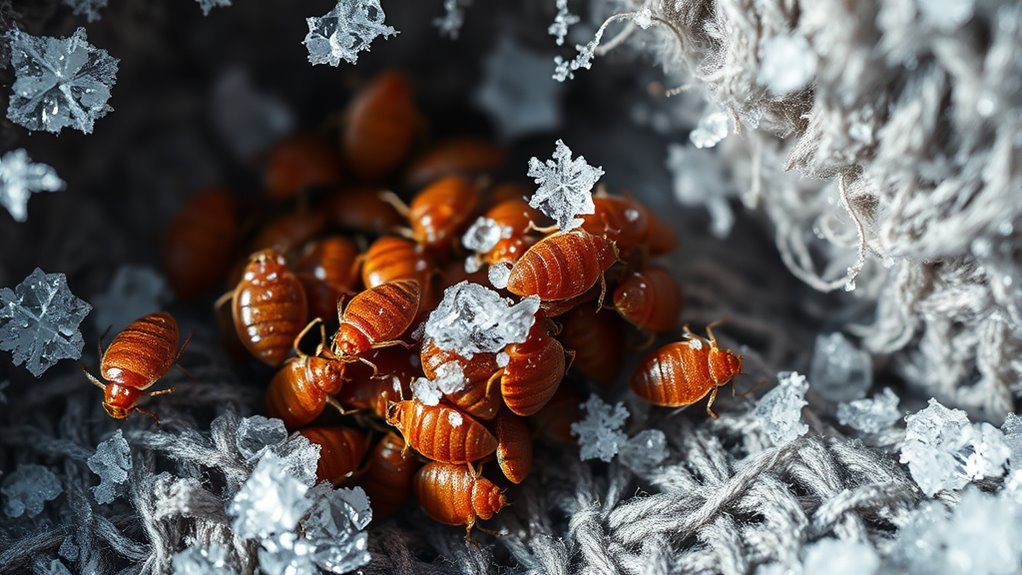
Although bed bugs prefer temperatures between 70-80°F for growth and reproduction, they can survive much colder conditions due to their evolutionary history.
Bed bugs thrive best at 70-80°F but can endure much colder temperatures thanks to their evolutionary past.
You should know that bed bugs’ temperature tolerance comes from ancestors that lived in cooler environments like bat caves.
When exposed to cold temperatures below 50°F, their development halts, which means their life cycle pauses but doesn’t stop them completely.
Bed bugs can enter a state called diapause at temperatures under 61°F, allowing them to survive unfavorable conditions.
While freezing infested items might seem effective, you need to expose bed bugs to 0°F or lower for at least four days to kill them.
Understanding these temperature limits helps you manage infestations more effectively.
Bed Bugs’ Ability to Survive Cold Environments
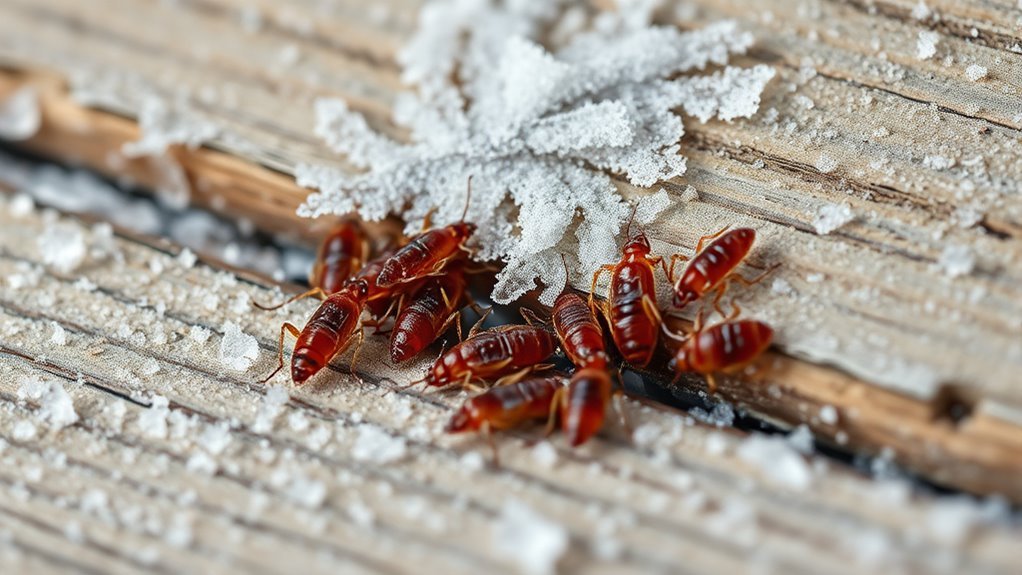
Because bed bugs descended from cave-dwelling insects, they’ve inherited a strong ability to survive cold environments that many pests lack.
When exposed to cold temperatures below 61°F, bed bugs can hibernate by slowing their metabolism, allowing them to endure until conditions improve.
Freezing bed bugs at 0°F for at least four days is typically necessary to kill all life stages.
Understanding temperature thresholds is essential since milder cold won’t eliminate infestations.
| Temperature Range | Bed Bug Response |
|---|---|
| Above 61°F | Active, feeding |
| Between 32°F and 61°F | Hibernate (dormancy) |
| 0°F (for 4+ days) | Temperatures can kill bed bugs |
This ability to hibernate helps bed bugs survive in various environments despite cold spells.
How Low Temperatures Affect Bed Bug Survival
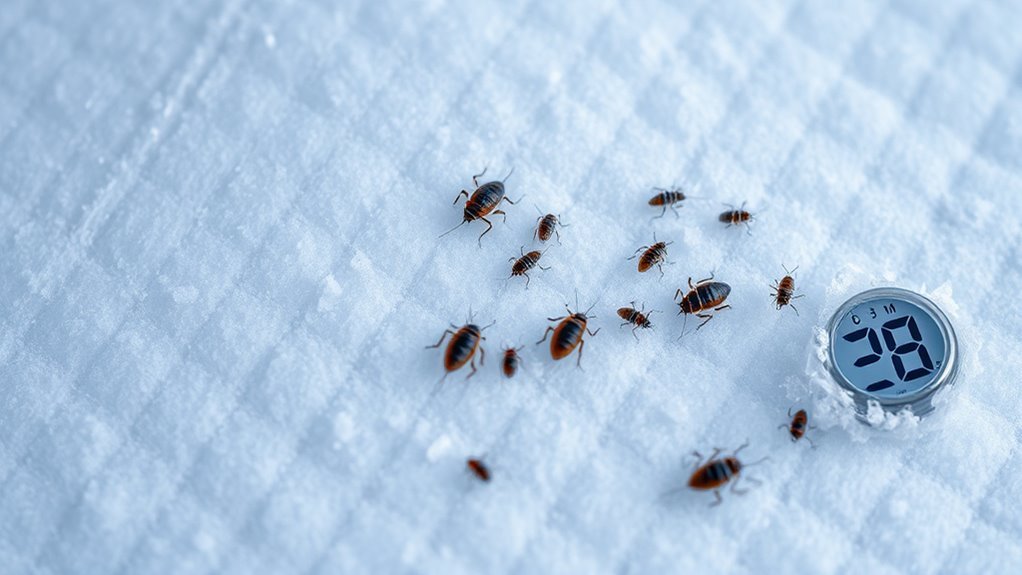
You might think freezing your home freezer can kill bed bugs quickly, but they actually survive in temperatures as low as -20°C for short periods.
To truly eliminate them, you need to expose them to 0°F (-18°C) or lower for at least four days.
Keep in mind, bed bugs can enter a dormant state to survive cold, so consistent freezing is key to stopping their life cycle.
Bed Bug Cold Tolerance
When temperatures drop below 61°F (16°C), bed bugs enter a dormant state. This slows their metabolism and helps them survive longer in the cold.
These insects show remarkable cold tolerance, enduring chilly conditions that might seem lethal.
Bed bugs can survive freezing temperatures temporarily, with adult females tolerating supercooling near -20°C (-4°F).
However, freezing alone isn’t a quick fix. Bed bug eggs exhibit even greater resistance to cold, often surviving short freezes, which complicates eradication efforts.
To effectively kill all bed bug life stages, you need prolonged exposure to extremely low temperatures. Typically, this is around 0°F (-18°C) for several days.
Understanding their cold resilience is crucial if you plan to use cold as a method to control infestations. But patience and precise conditions are key for success.
Freezing Thresholds and Impact
Although bed bugs can survive brief dips below freezing,
consistently maintaining temperatures at or below 0°F (-18°C) for at least four days is necessary to kill them effectively.
These freezing temperatures target all life stages, from eggs to adults, ensuring complete eradication.
Female bed bugs, for example, have a supercooling point near -20°C (-4°F), meaning they can survive short-term exposure slightly below freezing.
However, exposing them to even lower temperature thresholds, around -30°C (-22°F) for 3-4 days, is the most reliable method to stop bed bug survival altogether.
If the temperature isn’t held steady or the exposure is too brief, bed bugs can endure.
Freezing as a Method to Control Bed Bug Infestations
You can kill bed bugs by freezing infested items at 0°F (-18°C) for at least four days.
But it’s essential to maintain that temperature consistently.
Keep in mind that typical household freezers might not stay cold enough or long enough to fully eliminate all bugs and eggs.
Freezing works best for small, sturdy items like clothing or bedding.
However, it’s less practical for larger or delicate belongings.
Freezing Temperature Requirements
Since bed bugs can survive cold temperatures to a certain extent,
you need to freeze infested items at 0°F (-18°C) for at least four days to kill all life stages effectively.
Household freezers often fluctuate in temperature, so extending freezing time guarantees complete eradication.
Different items require varied freezing durations depending on size and material.
| Item Type | Freezing Temperature | Minimum Freezing Time | Purpose |
|---|---|---|---|
| Clothing | 0°F (-18°C) | 8 hours | Larger loads |
| Shoes | 0°F (-18°C) | 3 days | Textiles and footwear |
| Infested Items | 0°F (-18°C) | 4 days | Kill all bed bug stages |
| Adult Bugs | -4°F (-20°C) | N/A | Supercooling point |
| Household Freezer | 0°F (-18°C) | Extended time | Compensate temperature fluctuations |
Practical Limitations of Freezing
Freezing infested items at 0°F (-18°C) for several days can kill all bed bug life stages, but this method has clear limitations.
When considering freezing for bed bug eradication, you must understand the practical application is often restricted by several factors.
Household freezers may not maintain the required freezer temperature consistently.
And temperature fluctuation can extend the time needed to kill bed bugs effectively.
Additionally, freezing limitations make it impractical for large objects or fragile items.
Keep these points in mind:
Most freezers don’t sustain the necessary cold long enough for full bed bug eradication.
Large objects can’t be frozen thoroughly, reducing treatment effectiveness.
Plus, temperature fluctuations may require longer freezing periods to succeed.
Because of these constraints, freezing is best for small, solid items only.
Limitations of Using Cold Weather for Bed Bug Eradication
Although cold weather might seem like a natural solution, it rarely stays consistently below the temperatures needed to kill all bed bugs and their eggs.
Outdoor winter temperatures seldom remain below 0°F (-18°C), which is essential to eradicate bed bug populations effectively.
Consistently staying below 0°F (-18°C) is crucial to effectively eliminate bed bugs outdoors.
You might think placing infested items on a freezing bed outdoors could help, but fluctuating cold weather often leads to incomplete freezing.
Some bugs and eggs survive, especially since bed bugs can enter dormancy to withstand colder conditions.
Plus, bulky or insulated items rarely reach lethal temperatures throughout, allowing pests to live in cold environments.
Relying solely on cold weather for bed bug infestation control is unreliable because it doesn’t maintain the extreme, sustained cold needed to kill all life stages.
Combining Cold Treatment With Other Control Strategies
Cold treatment alone often falls short of fully eliminating bed bugs, but when you combine it with other control methods, your chances of success improve considerably.
Properly monitoring temperature and duration ensures the freeze kills all bed bugs and their eggs.
Combining cold treatment with other strategies targets different hiding spots and life stages, boosting control effectiveness.
Consider integrating these approaches:
- Use heat treatments or chemical pesticides alongside freezing to attack bed bugs from multiple angles.
- Apply cold treatment to fragile or non-washable items that can’t withstand heat or chemicals.
- Incorporate vacuuming and mattress encasements to physically remove and trap bed bugs.
These combined efforts can make a significant difference in your battle against bed bugs.
Seasonal Behavior and Winter Activity of Bed Bugs
Even when temperatures drop, bed bugs don’t simply disappear or go into hibernation.
Instead, they enter a dormant state called diapause at cold temperatures below 61℉ to enhance survival during harsh conditions.
You’ll find their winter activity mostly indoors, where heating shields them from outdoor cold.
They seek refuge in warm spots like bedding or wall voids, avoiding freezing temperatures outside.
Prolonged exposure to extreme cold (0°F or below for 4+ days) can kill bed bugs, but short cold snaps rarely do.
| Factor | Behavior in Winter | Impact on Survival |
|---|---|---|
| Dormancy | Enter diapause below 61℉ | Conserves energy |
| Shelter Seeking | Hide indoors, warm areas | Avoids outdoor cold |
| Cold Exposure | Rarely exposed to extreme cold | Survival depends on duration |
Preventing Bed Bug Infestations During Cold Seasons
Understanding how bed bugs survive the winter helps you take smarter steps to prevent infestations during colder months.
Since cold weather alone won’t kill bed bugs, you need to focus on effective control strategies to prevent bed bugs from settling in your home.
To minimize the risk of infestation during cold seasons, you should:
- Regularly inspect and clean bedding, furniture, and luggage to detect early signs of bed bugs.
- Freeze small, infested items at 0°F for at least four days to kill any hidden bugs.
- Seal cracks and crevices where bed bugs can hide and enter your home.
Frequently Asked Questions
How Long Does It Take for Bed Bugs to Die in Cold Weather?
It takes about four days at 0°F (-18°C) to eliminate bed bugs.
However, you’ll need even colder temperatures, like below -30°F (-34°C), for 3-4 days to guarantee all life stages die completely.
Can Cold Weather Get Rid of Bed Bugs?
Cold weather alone won’t get rid of bed bugs effectively because they survive mild cold and dormancy.
You’ll need professional freezing treatments or prolonged exposure to deep cold below 0°F to truly eliminate them.
Will Bed Bugs Come Back After Freezing?
Like a frostbitten warrior revived by spring, bed bugs can come back after freezing if you don’t freeze long enough or protect your items.
You’ve got to seal and guard them to keep the pests away.
Conclusion
You might think freezing temps would wipe out bed bugs completely, but their surprising cold tolerance tells a different story.
While freezing can kill some, many survive milder chills. This makes cold weather alone an unreliable weapon.
So, don’t rely just on winter’s bite. Instead, combine cold treatments with other methods to truly beat bed bugs.
In the battle against these resilient pests, it’s your smart, multi-pronged approach that wins every time.
To effectively eradicate bed bugs, remember that cold weather can be part of your strategy, but it shouldn’t be your only line of defense.
Using heat treatments, vacuuming, and insecticides in conjunction with cold exposure will increase your chances of success significantly.
In conclusion, a comprehensive approach is essential for tackling bed bugs. Combine freezing temperatures with other pest control methods for the best results.