How Is Pressure Treated Wood Made Weather-Resistant?
You make pressure treated wood weather-resistant by following a specific process that enhances its durability against the elements. First, the moisture content is carefully controlled, and the bark is removed to prepare the wood.
Next, the surface is incised, allowing preservatives to penetrate deeply. This step is crucial as it ensures that the protective chemicals can effectively reach the inner fibers of the wood.
Using a vacuum and high-pressure cycle, copper-based or borate chemicals are infused into the wood. This process creates a robust barrier that protects against decay, insects, and moisture damage.
After the treatment, any excess chemicals are drained and locked in through a final vacuuming process. This guarantees long-lasting protection and enhances the wood’s outdoor durability.
Keep exploring to understand how each step contributes to the effectiveness of pressure treated wood in weather resistance.
The Role of Preservative Chemicals in Weather Resistance
While weather can quickly degrade untreated wood, preservative chemicals play a crucial role in boosting its durability.
These chemicals, like copper-based compounds, borates, and creosote, enhance wood’s moisture resistance and protect it from decay and pests.
Copper, borates, and creosote boost wood’s resistance to moisture, decay, and pests.
Copper-based preservatives form strong chemical bonds with wood fibers, ensuring long-lasting defense against fungi and insects.
Borates penetrate deeply, offering protection mainly against biological threats, though they perform best in lower moisture conditions.
Tar-based preservatives such as creosote create a hydrophobic barrier that repels water, reducing weather-related damage.
The key to effective weather resistance lies in the retention level and penetration depth of these preservatives, combined with their chemical stability within the wood.
Preparing Wood for Effective Treatment
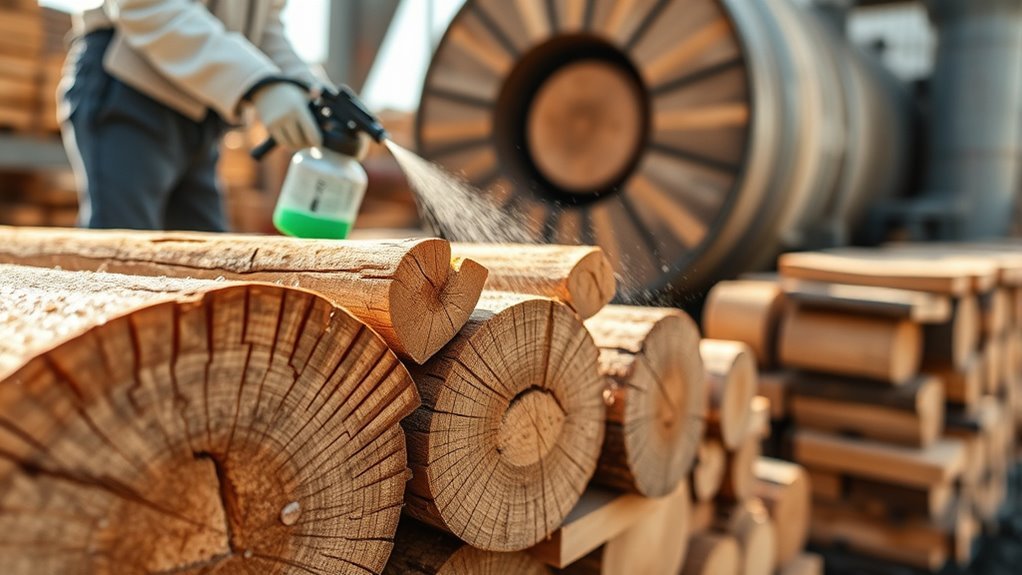
Before treating wood, you’ll want to control its moisture content by drying and debarking it. This improves preservative absorption.
Incising the wood with small grooves helps chemicals penetrate deeper, especially in thicker pieces.
These preparation steps guarantee the treatment bonds effectively, boosting the wood’s weather resistance.
Moisture Content Control
How do you guarantee wood absorbs preservatives effectively during pressure treatment?
You start by controlling the moisture content, keeping it typically between 19% and 28%.
Proper moisture levels ensure ideal chemical penetration, enhancing wood preservation.
Overly wet wood blocks preservative infusion, reducing retention and weather resistance.
Before treatment, wood is often debarked and dried using specialized equipment to reach the ideal moisture range.
This preparation step is vital for durable, weather-resistant timber.
| Step | Moisture Content (%) | Purpose |
|---|---|---|
| Debarking & Drying | 19% – 28% | Prepares wood for treatment |
| Moisture Measurement | Accurate control | Ensures optimal chemical penetration |
| Pressure Treatment | Maintains moisture | Enhances wood preservation |
Controlling moisture content is key to effective pressure treatment and long-lasting wood protection.
Wood Incising Techniques
Because dense or resinous woods naturally resist preservative absorption, you’ll need to use wood incising techniques to prepare them for effective pressure treatment.
Incising involves cutting small, shallow slits into the wood surface, allowing wood preservatives to achieve deep penetration during pressure treatment.
This process uses steel teeth pressed into the wood, opening its cellular structure without damaging its strength.
Here’s why incising matters:
- It helps overcome natural resistance in dense woods like Douglas fir.
- It ensures uniform absorption of preservatives for longer-lasting protection.
- It markedly increases preservative retention, especially in thicker sawed lumber.
Debarking and Drying
Why is removing bark and controlling moisture vital for pressure-treated wood?
Debarking removes the outer bark layer, which improves the penetration of preservatives and prevents surface contamination during treatment.
You’ll often see equipment like rosserhead or ring debarkers stripping bark efficiently from logs or sawn timber.
After debarking, drying plays an essential role in reducing the wood’s moisture content.
By lowering moisture content—typically to below 19%—you guarantee preservatives bond more effectively and reduce leaching over time.
Whether you choose air drying or kiln drying, these methods help achieve consistent moisture levels throughout the wood.
The Vacuum and Pressure Cycle Explained
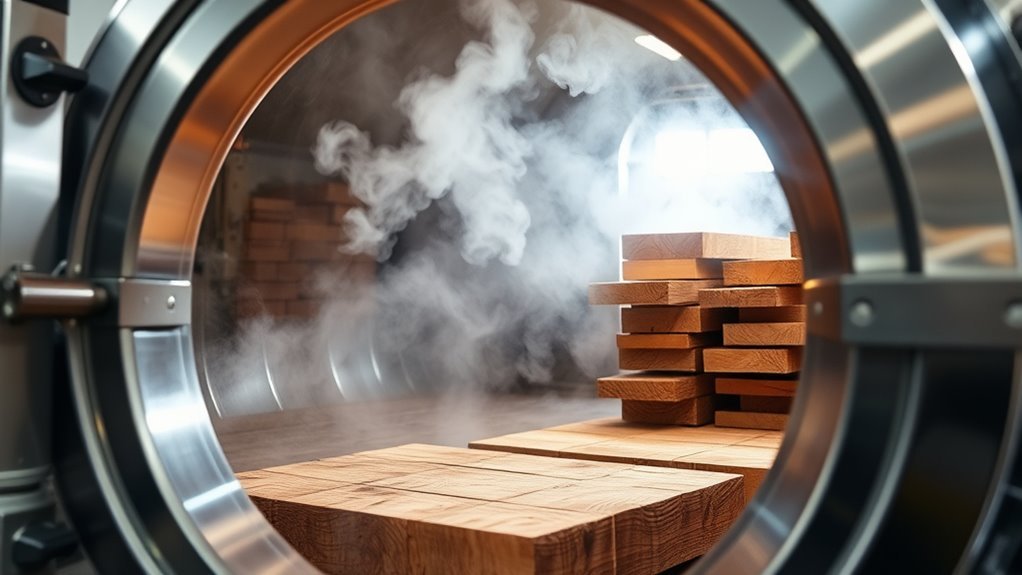
Ever wondered how pressure treated wood becomes so durable and weather-resistant?
It all starts with the vacuum and pressure cycle, a process designed to maximize preservative absorption deep into the wood’s cellular structure.
Here’s how it works:
- A vacuum removes air and moisture from the wood fibers, preparing them for treatment.
- Preservatives fill the sealed vessel, and pressure rises to 140-150 psi, forcing chemicals deep inside.
- The pressure holds steady to ensure uniform distribution, then excess preservative drains, and a final vacuum extracts surface residues.
This careful cycle guarantees the preservatives penetrate thoroughly, enhancing the wood’s resistance to weather and decay.
Without this vacuum and pressure method, wood wouldn’t achieve the same level of protection and durability.
How Preservatives Penetrate Wood Fibers
When you look closely at pressure treated wood, you’ll see that preservatives don’t just coat the surface—they’re driven deep into the wood fibers through a carefully controlled pressure process.
First, a vacuum removes air and moisture from the wood, creating space inside the fibers.
Initially, a vacuum extracts air and moisture, preparing the wood fibers for deep preservative infusion.
Then, under pressure—usually around 140-150 psi—the preservative solution is forced into the lumen and cell walls, ensuring thorough penetration.
Incising the wood’s surface helps by creating channels that allow the chemicals to reach deeper layers more uniformly.
After this, excess preservatives drain out, and a final vacuum pulls remaining chemicals further into the wood fibers.
This precise pressure and penetration method guarantees that preservatives protect the wood from within, making it highly weather-resistant and durable over time.
Types of Preservatives Used in Pressure Treatment
You’ll find that copper-based preservatives are popular for their strong, long-lasting protection against decay and insects.
Borate treatments offer great benefits indoors but aren’t suited for wet environments since they can wash away.
Meanwhile, organic chemical formulations provide alternative options, especially in industrial settings where deeper penetration is needed.
Copper-Based Preservatives
Although many preservatives exist, copper-based ones like ACQ (Aluminum Copper Quaternary) and CA (Copper Azole) dominate pressure-treated wood due to their proven effectiveness.
These copper preservatives are key in the pressure treatment process, offering reliable wood protection against fungi and insects. Their chemical formulation combines copper ions with agents that help the chemicals bond deeply within wood fibers.
Here’s why copper-based preservatives stand out:
- They provide long-lasting defense by being toxic to decay-causing organisms.
- Their environmental profile is better, leaching less than older arsenic treatments.
- Retention levels are carefully controlled (0.15 to 0.4 pounds per cubic foot) to balance durability and safety.
You can trust copper preservatives to make pressure-treated wood weather-resistant and safe.
Borate Treatment Benefits
How does borate treatment protect wood effectively?
Borate preservatives, like borax and boric acid, are water-soluble wood preservatives applied through pressure treatment.
This process forces borate deep into the wood’s cellular structure, guarding against decay, fungi, and insects.
You’ll find borate treatment especially useful for structural wood components such as beams and studs in dry or indoor environments.
However, since borate is water-soluble, exposure to moisture can cause it to leach out, reducing its effectiveness outdoors.
One big benefit is that borate is environmentally friendly and low in toxicity, making it safe around humans and animals when applied properly.
Organic Chemical Formulations
When selecting pressure-treated wood, understanding the types of chemical preservatives used is key to choosing the right product for your project.
The chemical formulations infused via pressure and vacuum processes create a durable, weather-resistant barrier. Here are three common wood preservatives you’ll encounter:
- Water-borne preservatives like MCA and ACZA use copper compounds that chemically bond with wood fibers. This offers long-lasting protection.
- Oil-based preservatives such as creosote and pentachlorophenol deeply penetrate wood. These are ideal for outdoor durability.
- CCA and borate treatments resist decay, insects, and fire. Borates are often favored for indoor use due to their lower toxicity.
Each formulation suits different exposure and safety needs.
Locking Preservatives Deep Into the Wood Structure
To guarantee your wood lasts through years of exposure, pressure treatment locks preservatives deep into its fibers by combining high pressure and vacuum cycles.
This process forces preservatives deep into the wood’s cellular structure, ensuring thorough penetration. Once inside, preservatives chemically bond with the wood’s lignin and cellulose, creating strong chemical bonds that prevent these protective agents from washing out over time.
Preservatives penetrate wood cells and bond chemically with lignin and cellulose for lasting protection.
This fixation is essential for long-lasting resistance against decay and insects. By carefully controlling pressure levels and treatment schedules, the process achieves uniform chemical penetration deep into the wood.
Quality control tests then verify that the preservatives are effectively locked in, ensuring your wood remains durable and weather-resistant for the long haul.
Post-Treatment Procedures for Long-Lasting Protection
Although the pressure treatment locks preservatives deep into the wood, ensuring long-lasting protection depends heavily on thorough post-treatment procedures.
Once treatment ends, you’ll want to:
- Place pressure-treated wood on a drip-pad for 24 to 48 hours to let excess preservatives drain off.
- Perform a final vacuum cycle to remove residual chemicals from the surface and internal pores, boosting chemical retention.
- Inspect the wood and attach end tags indicating preservative type, retention levels, and plant info for quality assurance.
These steps guarantee the wood maintains its weather-resistant properties and meets industry standards.
Applications and Benefits of Weather-Resistant Treated Wood
Ensuring pressure-treated wood undergoes proper post-treatment steps sets the stage for its reliable performance outdoors.
When you use pressure-treated wood infused with preservatives like MCA or borates, you get exceptional weather resistance that protects against decay, mold, and insect damage.
This makes it perfect for outdoor structures such as decks, fences, and garden beds, where exposure to rain, snow, and sunlight is constant.
The deep penetration of preservatives during treatment creates a durable barrier that prevents warping, splitting, and fungal decay.
By choosing pressure-treated wood with the right preservative retention, you ensure long-lasting structural integrity and durability.
Ultimately, this wood delivers superior protection and longevity, making it a smart choice for any outdoor project needing dependable weather resistance.
Frequently Asked Questions
How Weather Resistant Is Pressure-Treated Wood?
You’ll find pressure-treated wood highly weather-resistant, as its preservatives protect against rot, insects, and moisture.
With proper maintenance like sealing or staining, it can last many years, resisting warping, splitting, and decay outdoors.
How Do You Make Wood 100% Waterproof?
You can’t make wood 100% waterproof, but you can get close by applying high-quality sealants.
Sealing all edges is also crucial for preventing water from seeping in.
Using water-repellent preservatives can further enhance the wood’s resistance to moisture.
Choosing dense woods will give you a better chance at keeping the wood protected, too.
Lastly, maintaining the surface regularly is key to preventing moisture penetration.
How Does Pressure-Treated Wood Not Rot?
While untreated wood soaks up moisture and decays, you’ll find pressure-treated wood resists rot because chemicals deeply penetrate and lock in.
These chemicals block fungi and bacteria from growing, keeping your wood strong and long-lasting.
What Are the Downsides of Pressure-Treated Wood?
You’ll face chemical leaching risks, potential skin irritation, and environmental harm with pressure-treated wood.
It can warp, crack, and lose effectiveness over time, needing maintenance or replacement to avoid decay and pest problems.
Conclusion
You’ve seen how pressure-treated wood becomes a fortress against weather, with preservatives diving deep like rain soaking into thirsty soil.
By preparing the wood, using vacuum and pressure cycles, and locking in chemicals, the treatment creates a durable shield that stands up to time and elements.
With these steps, you’re not just protecting wood—you’re giving it the strength to weather any storm and last for years to come.
In conclusion, pressure-treated wood is specifically designed to resist the damaging effects of weather.
The combination of vacuum and pressure ensures that preservatives penetrate deeply, providing lasting protection.
This means your outdoor projects can withstand rain, sun, and snow, making pressure-treated wood an ideal choice for durability and longevity.