How Is a Hygrometer Used in Weather Monitoring?
You use a hygrometer to measure humidity, which is a crucial factor in weather monitoring.
Humidity influences cloud formation, rain, and storm development.
It provides real-time moisture data, helping detect changes like rising dew points or sudden humidity spikes that signal fog or storms.
Proper placement and calibration of the hygrometer ensure accurate readings.
Modern digital hygrometers even integrate with weather systems for precise forecasting.
By understanding how these devices work and their impact on severe weather prediction, we can see just how essential they are in meteorology.
They really play an important role in keeping us informed about weather conditions.
The Role of Humidity in Weather Patterns
Because humidity directly affects cloud formation, it plays an essential role in shaping the weather patterns you experience daily.
When humidity levels rise, the air holds more moisture, which increases relative humidity and promotes cloud development.
This process is fundamental for weather forecasting, as changes in humidity signal upcoming weather systems like storms or fronts.
High relative humidity often results in fog, dew, or frost, which can alter visibility and impact local conditions.
You’ll also notice that humidity influences how temperature feels, affecting heat index and wind chill calculations.
Humidity changes how we perceive temperature through its effect on heat index and wind chill.
By monitoring humidity, meteorologists gain insight into precipitation chances and severe weather events, helping them predict rainfall and thunderstorms more accurately.
Understanding humidity’s role helps you appreciate how air moisture shapes the weather around you.
Types of Hygrometers Used in Meteorology
While you might not see them often, various types of hygrometers play an essential role in meteorology by measuring humidity with different methods.
Psychrometers use dry and wet bulb thermometers to calculate relative humidity based on temperature differences.
Mechanical hair tension hygrometers rely on the changing length of hygroscopic hair to provide a visual humidity reading.
Dew point hygrometers measure the exact temperature where water vapor condenses on a chilled mirror, giving precise dew point data.
Meanwhile, capacitive and resistive electronic hygrometers offer fast, accurate readings, making them popular in weather stations.
Modern meteorology increasingly depends on digital sensors that wirelessly transmit humidity data for real-time analysis.
Each type of hygrometer helps you understand atmospheric moisture, which is essential for accurate weather forecasting.
Measuring Atmospheric Moisture With Hygrometers
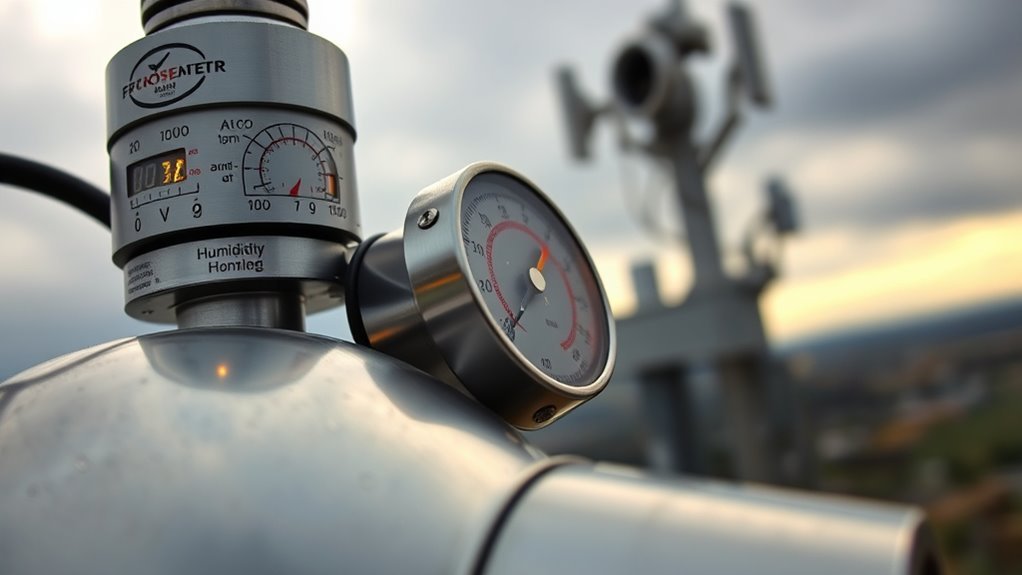
How do meteorologists gauge the moisture in the air?
They use a hygrometer to measure atmospheric moisture by detecting water vapor levels.
This instrument provides relative humidity readings, showing you how much moisture is present compared to the maximum air can hold at a given temperature.
Weather stations rely on hygrometers alongside thermometers and barometers for accurate humidity measurement, essential for forecasting rain, fog, or dew.
| Feeling Moisture | Impact on Weather |
|---|---|
| Dry air | Clear skies, comfort |
| Moderate humidity | Mild weather, balanced |
| High humidity | Rain, storms, discomfort |
Using a hygrometer helps you understand atmospheric moisture.
This understanding enables precise weather predictions and better preparation for changing conditions.
Placement and Calibration of Weather Station Hygrometers
You’ll want to place your hygrometer about 5 feet above the ground in a shaded, well-ventilated spot away from heat sources and airflow disruptions.
Regular calibration using saturated salt solutions or standard devices keeps your readings accurate and reliable.
Checking calibration monthly or quarterly helps catch sensor drift before it affects your data.
Optimal Sensor Placement
Because accurate humidity readings depend heavily on sensor location, you should place your hygrometer at least 5 feet above ground.
Make sure it’s in a shaded, well-ventilated spot away from direct sunlight and HVAC vents.
Proper sensor placement avoids temperature biases and guarantees the device measures true ambient humidity.
You’ll also want to keep it away from moisture sources like leaks or dew, which can distort readings and harm sensor integrity.
Good ventilation around the sensor promotes stable airflow, enhancing measurement reliability.
While calibration ensures accuracy, ideal placement minimizes environmental interference, reducing the need for frequent adjustments.
Calibration Techniques
Placing your hygrometer correctly sets the stage for accurate humidity measurements.
But regular calibration keeps those readings reliable over time. To maintain accuracy, you should calibrate your device at least every six months or after any suspected drift.
One effective method involves using salt solutions, which create a stable environment with a known relative humidity. By comparing your hygrometer’s reading to this reference, you can identify and correct any discrepancies.
Make sure your hygrometer is mounted in a shaded, well-ventilated spot at least 5 feet above ground. It should be away from direct sunlight and heat sources, which can prevent measurement errors.
Consistent calibration guarantees your weather station provides trustworthy humidity data. This data is vital for weather forecasting and scientific research.
Integration of Hygrometers in Automated Weather Systems
When you integrate digital hygrometers into automated weather systems, you gain continuous, real-time humidity data that enhances monitoring accuracy.
These humidity sensors—like capacitive or resistive types—connect to microcontrollers such as Arduino or Raspberry Pi for automated monitoring.
The collected humidity data is displayed locally, stored, or uploaded to cloud platforms, enabling remote access and efficient weather system management.
| Component | Function |
|---|---|
| Digital Hygrometers | Measure humidity continuously |
| Humidity Sensors | Detect moisture levels |
| Microcontrollers | Automate data collection |
| Data Loggers | Store and display readings |
| Cloud Platforms | Provide remote data access |
Hygrometer Data in Forecasting Rainfall and Fog
When you monitor humidity with a hygrometer, you get vital clues about condensation, dew point, and fog formation.
High humidity levels often signal that the air is close to saturation, which helps you predict rainfall events.
Humidity’s Role in Condensation
Because hygrometers measure relative humidity, they play an essential role in showing you how likely condensation will form on surfaces like windows and the ground.
When moisture levels rise, water vapor reaches saturation, causing condensation. Your hygrometer readings help weather forecasts predict these changes accurately.
Here’s how humidity influences condensation:
- High relative humidity signals moisture-packed air, increasing condensation chances.
- Hygrometer data helps identify when water vapor will condense into dew or fog.
- Sudden drops in humidity readings warn you that dry air reduces condensation risk.
- Accurate moisture level tracking lets meteorologists set thresholds for predicting rain and fog.
Dew Point and Fog
How can you tell if fog or rain is likely to form?
By monitoring the dew point temperature with a hygrometer, you get a clear picture of the air’s moisture content. When the dew point closely matches the current air temperature, humidity is high, and water vapor starts condensing.
This condition is vital for fog formation near the ground. Hygrometer readings allow you to detect when the dew point is reached, signaling that fog or precipitation might develop soon.
By continuously tracking dew point variations, you can anticipate these changes more accurately.
Understanding how dew point and humidity interact helps you predict when the atmosphere is saturated enough for water vapor to turn into droplets, leading to fog or rain.
Predicting Rainfall Events
Tracking dew point and humidity gives you valuable clues about the atmosphere’s moisture content, which directly affects rainfall and fog formation.
A hygrometer measures moisture by tracking relative humidity, helping you spot changes in humidity conditions that signal upcoming precipitation.
When water vapor rises and relative humidity exceeds 80%, the chances of rain or fog increase markedly.
Weather forecast models use this hygrometer data alongside temperature and pressure to predict rainfall events accurately.
Here’s how you can use hygrometer data to predict rainfall:
- Monitor sudden humidity changes that indicate rising moisture.
- Track sustained high relative humidity levels.
- Observe trends in dew point and humidity conditions.
- Combine hygrometer readings with other weather data for forecasts.
Hygrometers and Severe Weather Prediction
When you monitor humidity levels with a hygrometer, you gain essential insight into the likelihood of severe weather events like thunderstorms and cyclones.
Atmospheric humidity directly affects cloud formation and precipitation, so measuring it accurately is fundamental in weather monitoring.
A hygrometer helps you detect high humidity levels, which often signal the potential for severe weather.
Rapid shifts in humidity can warn you of approaching storms or tornadoes.
By continuously tracking these changes, you can better anticipate intense weather outbreaks.
Meteorologists rely on precise humidity data from hygrometers to forecast conditions that favor hurricane intensification and tornado development.
Using a hygrometer in your weather monitoring toolkit enhances your ability to predict and prepare for severe weather, ultimately improving safety and response strategies.
Advancements in Digital Hygrometer Technology
As sensor technology has advanced, digital hygrometers have become faster and more accurate, making them essential tools for precise humidity measurement.
You’ll find that modern electronic hygrometers use capacitive or resistive sensors for quick, reliable data. These devices often include temperature compensation to maintain accuracy regardless of environmental changes.
Plus, IoT integration lets you monitor humidity trends remotely and analyze data over time. Here are four key advancements to note:
- Capacitive and resistive sensors provide rapid, precise humidity measurement.
- Digital displays and wireless data transmission connect you directly to weather stations or smartphones.
- Temperature compensation algorithms ensure consistent accuracy in varying conditions.
- IoT and microcontrollers enable long-term data logging for better climate insights.
These innovations make digital hygrometers indispensable in modern weather monitoring.
Frequently Asked Questions
How Is a Hygrometer Used to Measure Weather?
You use a hygrometer to measure the air’s humidity, which helps you understand moisture levels affecting weather.
This data lets you predict fog, rain, or dryness.
Improving your overall weather forecasts and environmental awareness is a big plus!
Does 80% Humidity Mean the Air Is 80% Water?
No, 80% humidity doesn’t mean the air’s 80% water.
It means the air holds 80% of the maximum moisture it can manage at that temperature.
What Is the Difference Between a Barometer and a Hygrometer?
You use a barometer to measure air pressure for predicting weather changes,
while a hygrometer measures humidity levels to monitor moisture in the air.
They serve different roles but both are essential for accurate weather tracking.
What Are the Disadvantages of a Hygrometer?
You’ll face issues like calibration errors, slow response to humidity changes, and sensor drift.
Mechanical parts wear down, and external factors like sunlight or temperature swings can mess with readings, making hygrometers less reliable at times.
Conclusion
You rely on hygrometers to track humidity, a key factor influencing weather patterns like rainfall and fog.
Did you know that relative humidity levels above 90% often signal upcoming precipitation?
By accurately measuring atmospheric moisture, hygrometers help you anticipate these changes, especially when integrated into automated systems.
As digital technology advances, your ability to predict severe weather improves.
This makes hygrometers indispensable tools in modern meteorology.
In conclusion, hygrometers play a crucial role in monitoring weather patterns by measuring humidity levels.
Their ability to signal impending rainfall and other weather changes is vital for accurate forecasting.
With advancements in technology, these instruments enhance our understanding of atmospheric conditions, making them essential for anyone interested in meteorology and weather prediction.