10 Essential Tips to Pour Concrete in Cold Weather
To pour concrete successfully in cold weather, it’s crucial to select a high-strength, air-entrained mix that includes accelerators.
Reducing water content will also boost durability, which is essential when temperatures drop.
Preheating your water and aggregates is a smart move, as it helps maintain optimal conditions for curing.
Make sure to clear and insulate the pour site, while also monitoring the concrete temperature to keep it above 50°F during the curing process.
Using insulated forms like ICFs can help retain heat, and don’t forget to protect work areas with enclosures.
It’s also important for workers to wear proper cold-weather gear to stay safe and comfortable.
By following these tips, you can avoid freeze damage and ensure strong, lasting concrete.
Discover more ways to master cold-weather pours here!
Selecting the Appropriate Concrete Mix for Cold Weather
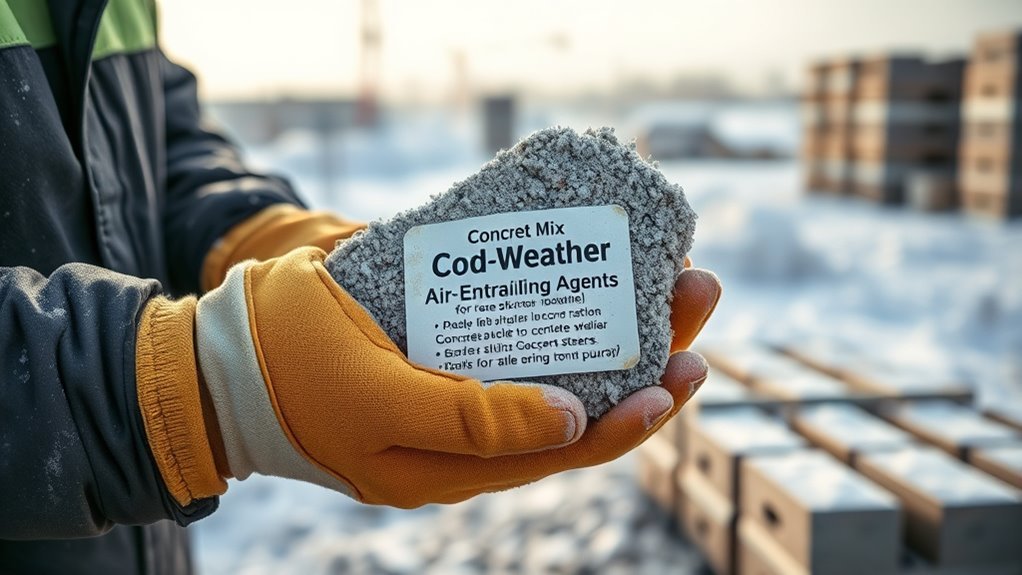
When pouring concrete in cold weather, you’ll want to choose a mix designed to handle freezing temperatures and speed up curing.
Start with a high-strength, air-entrained concrete that has at least 4,000 psi to protect your concrete from freezing and withstand freeze-thaw cycles.
Incorporate accelerants, like calcium chloride or non-chloride alternatives, to boost hydration and early strength development. This ensures proper curing even in the cold.
Increasing the cement content by about 100 pounds per cubic yard generates extra heat during curing, which helps prevent freezing.
Also, lower the water-cement ratio using plasticizers to improve durability and reduce the risk of freezing damage.
Selecting a cold-weather-specific mix guarantees your concrete sets, cures properly, and performs long-term despite chilly conditions.
Preparing the Site and Materials Before Pouring
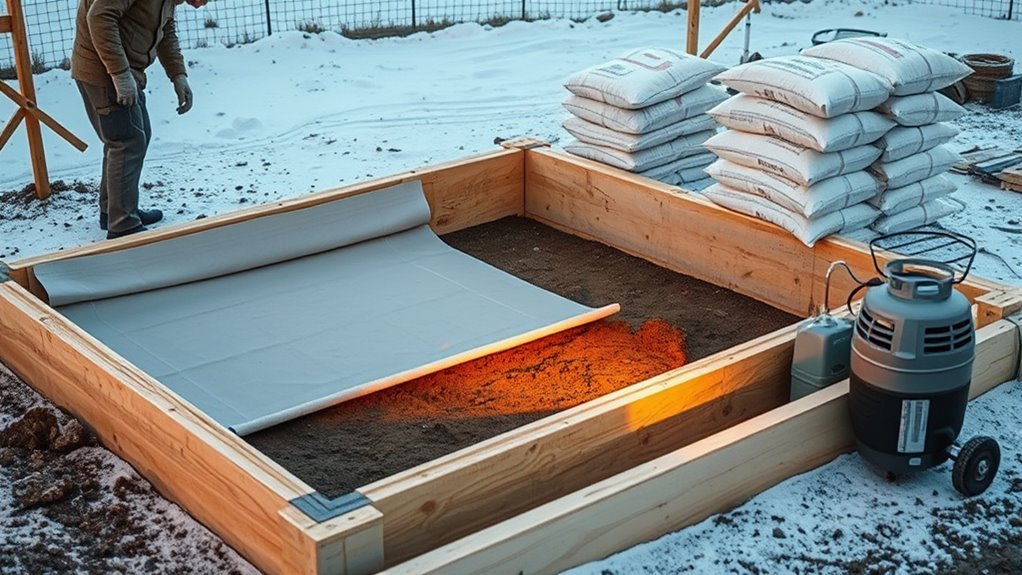
Before you pour concrete in cold weather, make sure to pre-heat your water and aggregates to prevent cold shock.
Clear the pour area of any ice, snow, or standing water to guarantee proper bonding.
Finally, protect your site and materials from wind and freezing temperatures using tarps or enclosures to maintain a stable curing environment.
Pre-heat Materials
Although cold weather challenges concrete pouring, you can improve results by pre-heating your materials.
Start by warming the water to about 140°F (60°C) before mixing. This helps the concrete cure evenly and reduces the risk of freezing.
Also, raise the aggregate temperature to roughly 180°F (82°C) to maintain the mix’s overall warmth.
Properly pre-heated water and aggregate temperature ensure the concrete sets correctly despite cold conditions.
Avoid using cold materials straight from storage, as this lowers the mix temperature and slows curing.
Warming these components helps prevent cold-related weaknesses and enhances early strength.
Clear Pour Area
Pre-heating your materials sets the stage for a successful concrete pour, but you also need to prepare the pour area carefully.
To guarantee optimal concrete temperature and bonding, clear the pour area of ice, snow, and standing water.
Make sure the ground is fully thawed and consistent in temperature to prevent uneven curing or thermal cracking.
| Task | Purpose | Tips |
|---|---|---|
| Remove ice & snow | Ensure proper bonding | Use shovels, blowers, or salt |
| Clear standing water | Prevent weak spots | Pump out or absorb with towels |
| Thaw ground | Avoid thermal cracking | Use ground heaters or insulation |
| Store tools indoors | Maintain tool condition | Keep in heated storage |
| Maintain concrete temp | Promote curing | Coordinate with pre-heated materials |
Preparing the clear pour area is critical for a durable, cold-weather concrete pour.
Protect From Elements
While cold weather can challenge your concrete pour, protecting your site and materials from the elements helps guarantee a strong, consistent cure.
Start by pre-heating water to 140°F and aggregates to 180°F to prevent the concrete from cooling too quickly.
Remove all ice, snow, and standing water from the pour area to ensure proper bonding and curing concrete.
Use windproof enclosures, blankets, or tarps to shield the concrete and materials from cold winds.
Store your tools and materials indoors or in heated spaces to maintain their quality.
Insulate the ground with straw or foam to keep the subgrade temperature steady and support curing concrete.
Taking these steps will effectively protect from elements and promote a durable, reliable concrete pour.
Using Heated Water and Aggregates in the Mix
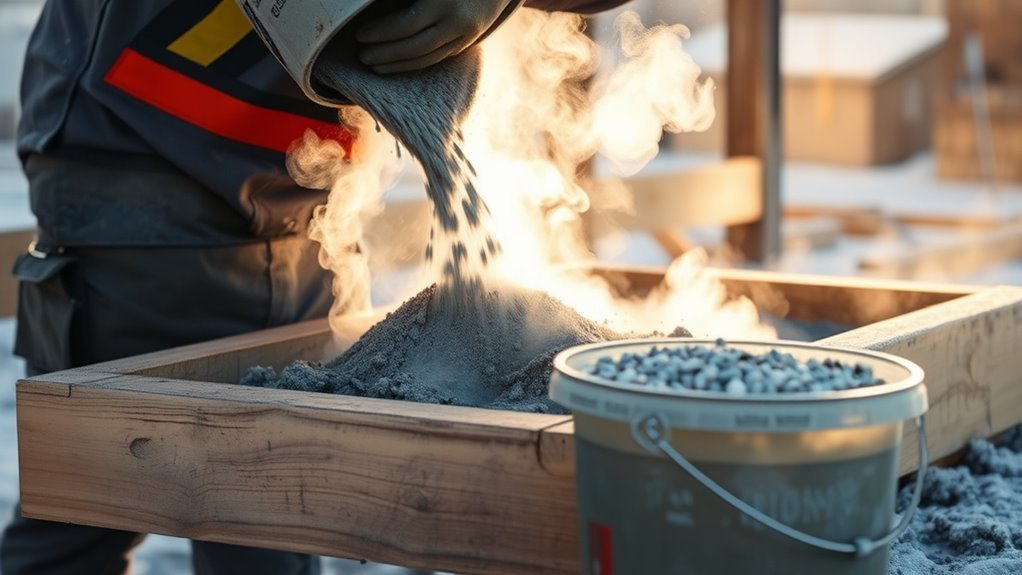
When you use heated water and aggregates in your concrete mix, you help maintain an ideal temperature that supports better curing during cold weather.
Preheating water to around 140°F and aggregates to about 180°F raises the mix’s initial temperature, which improves workability and accelerates hydration.
This reduces the risk of the concrete freezing before it gains strength.
Heated water boosts the curing process, while properly warmed aggregates ensure the mix stays warm overall, promoting early strength development.
Consistently heating these components prevents thermal shock, helping you achieve uniform curing conditions.
Incorporating Admixtures to Accelerate Setting and Improve Durability
Because cold weather slows concrete curing, you’ll want to incorporate admixtures that speed up setting and boost durability.
Accelerators like calcium chloride or non-chloride options enhance hydration and reduce setting time. This ensures the concrete gains strength quickly.
Air-entraining admixtures introduce tiny bubbles that improve freeze-thaw resistance. This increases durability in cold conditions.
These admixtures also allow a lower water-cement ratio, making your concrete denser and less prone to freezing damage.
| Admixture Type | Function | Benefit in Cold Weather |
|---|---|---|
| Calcium Chloride | Accelerator | Speeds setting time, early strength |
| Non-Chloride Accelerators | Accelerator | Avoids corrosion, speeds setting |
| Air-Entraining Agents | Freeze-thaw resistance | Improves durability |
| Water-Reducing Agents | Lowers water content | Increases density, reduces freeze risk |
Controlling Concrete Temperature During and After Placement
Incorporating the right admixtures helps your concrete set faster and resist freeze-thaw damage.
But you still need to keep its temperature in check during and after placement. Maintaining concrete temperature above 50°F (10°C) throughout curing is vital for proper strength development.
Keep concrete temperature above 50°F during curing to ensure optimal strength development.
Use infrared or dial thermometers to monitor concrete temperature continuously. Place concrete promptly after delivery to minimize heat loss and keep it within ideal curing ranges.
Prevent temperature drops below 40°F (4.5°C) during the first 24 hours to avoid reduced strength and cracking.
Employ insulating blankets, windbreaks, and supplemental heat sources as needed to maintain consistent warmth.
Applying Insulation and Enclosure Techniques for Curing
To protect your concrete from cold air and retain essential heat, you should insulate the work area using materials like straw, foam sheeting, or tarps secured firmly with wood or plastic.
This insulation shields your concrete during the vital curing process, preventing rapid cooling and thermal cracking.
Use waterproof windbreaks and foam barriers to block wind and moisture loss, maintaining stable conditions.
Secure enclosures well to withstand wind and temperature changes.
Keep curing blankets on for at least three days to preserve heat and promote proper hydration.
| Insulation Material | Purpose |
|---|---|
| Straw | Retains heat |
| Foam Sheeting | Provides thermal barrier |
| Tarps | Protects from moisture |
| Windbreaks | Shields from wind |
| Curing Blankets | Maintains hydration |
Managing Ground and Subgrade Conditions Before Pouring
Before you pour concrete in cold weather, make sure the ground and subgrade are properly prepared and thawed.
Use heaters, hot sand, or steam to raise the ground temperature to at least 50°F (10°C). This helps match it closely with the concrete’s temperature to prevent freezing.
Remove all ice, snow, and standing water to create a stable, dry foundation.
Once thawed, insulate the ground with straw, foam, or waterproof barriers. This blocks cold air and reduces moisture loss during curing.
Check that any heating equipment runs safely and efficiently. You want to avoid carbon monoxide buildup and uneven heat distribution.
Managing these ground and subgrade conditions guarantees your concrete cures correctly and maintains its strength, even in cold weather.
Adjusting Formwork and Structural Support for Cold Conditions
After preparing and insulating the ground, focus on adjusting your formwork and structural support to handle cold conditions.
Keep your formwork in place as long as possible to allow even heat distribution and prevent premature cooling of the concrete.
Make sure reinforcement steel and post holes are free of ice, snow, and frost before you pour to ensure proper bonding.
Use insulated formwork or add thermal barriers to retain heat during early curing and protect the concrete from cold ambient temperatures.
Don’t rush to remove forms; wait until the concrete has sufficiently cured and warmed to avoid cracking.
Remove formwork gradually only after the concrete has gained enough strength and temperature.
These steps will help your concrete cure properly despite the cold.
Ensuring Worker Safety During Cold Weather Concrete Work
You’ll need to watch for cold stress signs like hypothermia and frostbite to keep your crew safe.
Make sure everyone wears layered clothing, insulated gloves, and waterproof boots to stay warm and dry.
Don’t forget to schedule regular breaks in heated areas so workers can recover from the cold.
Cold Stress Awareness
How can you keep your crew safe while pouring concrete in freezing temperatures?
Cold stress poses serious risks like hypothermia and frostbite, so protecting workers is vital.
You need to educate your team to spot early cold stress signs—shivering, numbness, fatigue, confusion—and respond quickly.
Follow OSHA guidelines and create a safe work environment by:
- Enforcing work/rest cycles to minimize cold exposure
- Providing heated shelters or warming stations
- Ensuring workers wear layered clothing, thermal gloves, insulated boots, and headgear
- Monitoring workers closely for symptoms of cold stress
Protective Clothing Requirements
Keeping your crew safe from cold stress involves more than just monitoring their health—it means equipping them with the right protective clothing.
In cold temperatures, you should insist on layered, insulated clothing, including thermal gloves and hats, to guard against frostbite and cold stress while pouring concrete.
Protective gear like waterproof boots, eye protection, and face shields also plays a vital role in shielding workers from biting wind and splashes of cold concrete.
This gear not only keeps them comfortable but reduces injury risks.
By prioritizing proper clothing and protective gear, you create a safer work environment.
This helps your team maintain focus and productivity despite harsh winter conditions.
Always guarantee your crew understands the importance of wearing appropriate gear when working in cold temperatures.
Work-Rest Scheduling
Although cold weather poses serious risks during concrete work, you can protect your crew by implementing effective work-rest schedules.
Proper work-rest scheduling reduces cold stress and keeps your team safe and productive. Rotate workers every 30 minutes to limit exposure and prevent hypothermia or frostbite.
Here are key strategies to follow:
- Schedule pours during the warmest part of the day, typically late morning to early afternoon.
- Provide heated shelters or warm-up stations near the work area.
- Require workers to wear layered clothing, insulated gloves, and thermal footwear.
- Train your crew to recognize early cold stress symptoms for timely intervention.
Leveraging Insulated Concrete Forms (ICFs) for Winter Construction
When you use Insulated Concrete Forms (ICFs) like Fox Block, you can pour concrete at temperatures as low as -5°F (-15°C) without extra heating.
ICFs retain hydration heat and prevent freezing, so you won’t need additional heating or hoarding around your walls.
In cold weather, these forms maintain core concrete temperatures near 100°F (38°C) for at least 24 hours, even when outside temperatures dip to 19°F (-7°C).
Using ICFs speeds up your project by reducing construction delays and boosts energy efficiency with airtight, moisture-resistant walls.
Their high R-values above 23 ensure significant winter energy savings and long-term durability.
If you want to tackle concrete in cold weather effectively, leveraging ICFs is a smart, reliable choice for winter construction.
Frequently Asked Questions
How Do You Pour Concrete in Cold Weather?
You pour concrete in cold weather by using a warm, specially designed mix.
It’s important to keep materials heated to ensure proper consistency.
Placing the concrete quickly is crucial to prevent it from freezing.
You can protect it with insulated blankets or enclosures to maintain temperature.
This helps prevent freezing during the curing process.
What Is the 10/20/30/40 Rule When Making Concrete?
The 10/20/30/40 rule means you add extra cement per cubic yard—10 pounds for every 10°F drop below 50°F.
It helps your concrete cure properly and stay strong in colder temperatures.
What Is the Coldest Temperature You Should Pour Concrete At?
Imagine planting a delicate seed in a frozen field; you shouldn’t pour concrete colder than 20°F (-6.5°C) unless you wrap it warmly.
With proper care, you can protect it even in harsh, freezing conditions.
What Is the Code for Pouring Concrete in Cold Weather?
There’s no universal code for pouring concrete in cold weather.
You’ll need to follow your local building codes and standards like ACI 306.
These guidelines help ensure proper curing and prevent freezing during placement.
Conclusion
When pouring concrete in cold weather, you’ve got to plan carefully—from choosing the right mix to keeping it warm after pouring.
Imagine a small-town contractor who used heated water and insulated forms during a winter bridge repair.
By following these tips, they prevented cracking and ensured durability despite freezing temperatures.
With the right preparation and techniques, you can pour strong, lasting concrete no matter how cold it gets outside.
So, remember, it’s all about being proactive.
Choosing the right materials and taking steps to keep everything warm can make a huge difference.
It’s crucial to pay attention to every detail to avoid issues later on.
In conclusion, pouring concrete in cold weather requires careful planning and the right strategies.
By using heated water, insulated forms, and the proper mix, you can achieve durable results.
Stay prepared and implement these techniques to ensure your concrete withstands the harsh winter conditions!