
10 Essential Tips You Need to Pour Concrete in Freezing Weather
To pour concrete successfully in freezing weather, it’s crucial to follow some essential tips. This process can be tricky, but with the right preparation and materials, you can achieve strong results even in cold conditions.
First, choose a high-strength, air-entrained mix enriched with accelerators and increased cement content.
Next, thaw and prepare your site thoroughly, ensuring materials are warmed as needed.
Keeping the concrete temperature above 50°F during curing is vital. You can achieve this by using insulated blankets or heated enclosures.
Additionally, protect your concrete from wind and moisture loss.
Using insulated concrete forms can also enhance heat retention.
Don’t forget to prioritize worker safety—make sure everyone wears proper gear and takes regular breaks.
These vital steps will help your concrete set strong despite the cold.
Understanding how each plays an essential role can make all the difference.
Choose the Right Concrete Mix for Cold Conditions
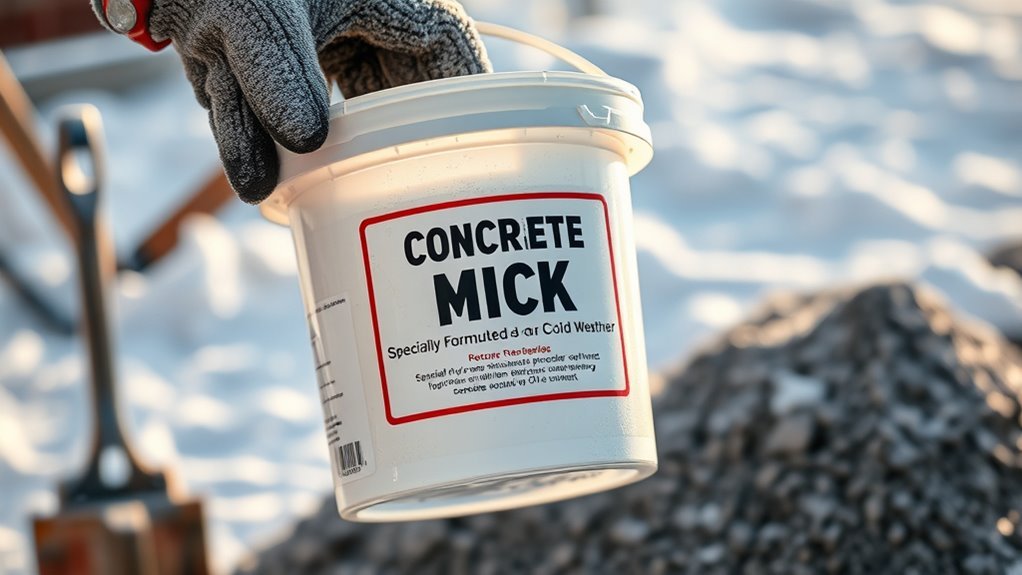
When pouring concrete in freezing weather, you’ll want to choose a mix designed to withstand cold conditions.
Start with high-strength concrete, ideally air-entrained and with at least 4,000 psi, to handle freeze-thaw cycles.
Choose air-entrained concrete with a minimum 4,000 psi to resist freeze-thaw damage effectively.
Incorporate accelerators to speed up setting and strength gain, which is vital in low temperatures.
Opt for Type III Portland cement, known for its faster hydration, helping your project gain strength quickly.
Don’t forget cold-weather admixtures that improve workability and performance despite the chill.
Including moisture-retaining admixtures is necessary—they help maintain hydration and reduce freezing damage risk.
Also, adjust the water-cement ratio carefully to optimize the mix.
Prepare the Site and Materials Thoroughly Before Pouring
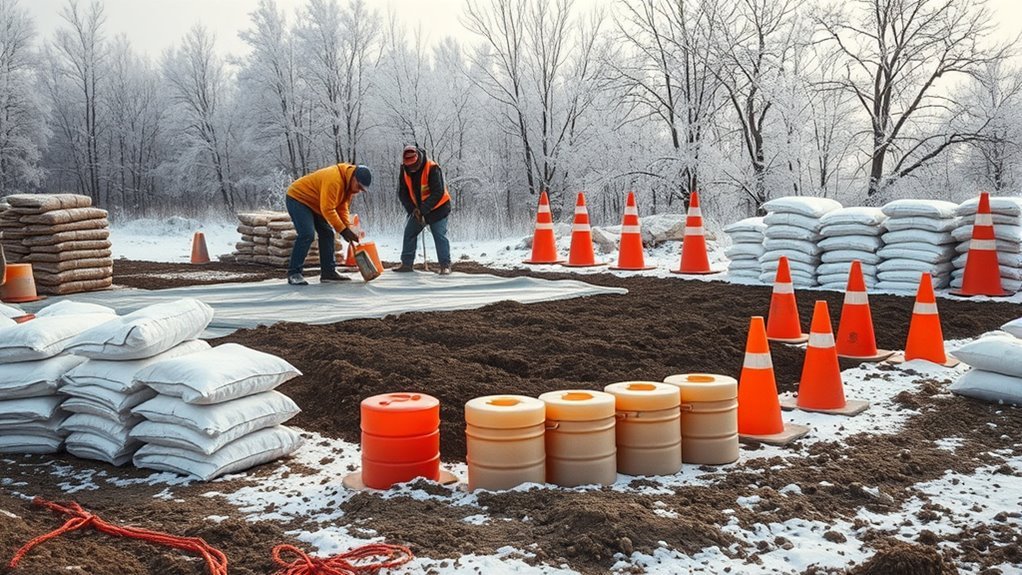
Before you pour, make sure the ground is completely thawed and free of ice, snow, or water to avoid weak spots.
It’s crucial to have a solid foundation!
Warm your materials, like water and aggregates, to keep the concrete mix at the right temperature.
Also, store your tools and forms in a warm place to prevent cold damage and guarantee a smooth pour.
Preparation is key for a successful project!
Clear Ice and Snow
How can you guarantee your concrete sets properly in freezing weather?
First, you must clear all ice and snow from the surface.
Proper surface preparation is critical because any ice, snow, or standing water can disrupt curing and weaken the bond.
Freezing temperatures demand that you remove these hazards to ensure your concrete adheres well and cures evenly.
| Challenge | Solution |
|---|---|
| Ice on the surface | Remove completely before pour |
| Snow accumulation | Clear thoroughly |
| Frozen ground | Thaw at least 12-18 inches deep |
| Risk of poor curing | Use insulation and coverings |
Warm Materials and Ground
Although cold weather poses challenges, warming your materials and ground thoroughly guarantees your concrete sets properly.
Start by pre-heating your water to 140°F and aggregates to 180°F to keep the mix from cooling too fast.
Remove any ice, snow, or standing water from the pour area to ensure proper bonding.
You’ll also need to thaw the ground to at least 12-18 inches deep using heated ground methods or ground heaters.
Keep your tools, reinforcement, and insulated formwork in heated storage to prevent cold damage.
Maintaining a stable ground temperature and warm materials throughout the curing concrete process is essential for maximum strength.
Maintain Optimal Concrete Temperature During and After Pouring
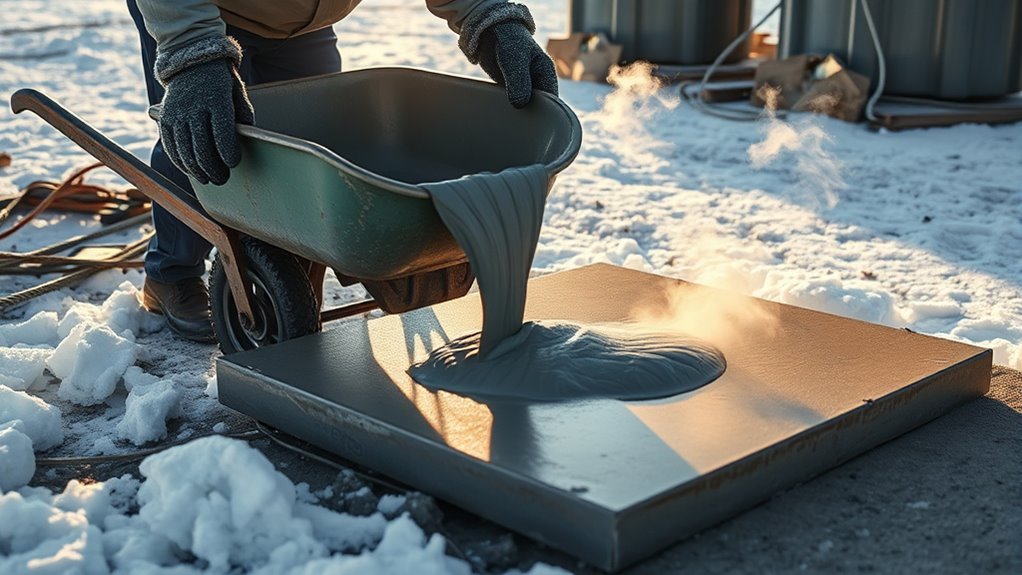
You’ll want to keep a close eye on your concrete’s temperature using infrared or dial thermometers.
This ensures it stays above 50°F during curing.
Using insulated blankets or heated enclosures helps protect your pour from freezing temperatures.
Prompt placement and continuous monitoring are key to maintaining the right conditions for strong, durable concrete.
Temperature Monitoring Methods
When pouring concrete in freezing weather, you need to monitor its temperature closely to guarantee proper curing and strength development.
Effective temperature monitoring helps ensure the concrete temperature stays within the ideal curing temperature range.
You can use a thermometer—either infrared or dial—to take regular surface readings.
For more accurate data, embed internal sensors in the concrete mass to detect cold spots early.
Keep a detailed log of temperature readings every 2-4 hours to track trends and adjust as needed.
Here are key temperature monitoring methods to use:
- Use infrared thermometers for quick surface temperature checks.
- Embed internal sensors for continuous concrete temperature monitoring.
- Record curing temperature regularly to maintain proper hydration conditions.
These steps help you maintain suitable conditions during and after pouring.
Protective Measures
Monitoring concrete temperature closely helps you identify when protective measures are necessary to maintain ideal curing conditions.
To keep concrete above 50°F during and after pouring, use insulated blankets or heated enclosures immediately after finishing. These help prevent heat loss and freezing.
You should also install windbreaks and waterproof covers to shield the concrete from cold winds and moisture loss.
Regular temperature monitoring with infrared or dial thermometers ensures the concrete stays above 40°F during the vital first 24 hours.
By combining these steps—insulated blankets, heated enclosures, waterproof covers, windbreaks, and constant temperature monitoring—you’ll maintain excellent conditions for curing.
This approach helps your concrete develop strength properly, even in freezing weather.
Use Accelerating Admixtures to Speed Up Setting and Strength Gain
Although cold temperatures slow down concrete curing, you can speed up setting and strength gain by using accelerating admixtures like calcium chloride or non-chloride accelerators.
These admixtures reduce setting time and boost early strength by enhancing the hydration process, which is vital in cold weather.
By incorporating them, you can achieve compressive strengths of 500 PSI or more within 24 hours. This helps your project stay on schedule despite freezing conditions.
Remember to select admixtures compatible with your reinforcement materials to avoid cracking or corrosion.
Always follow manufacturer dosage guidelines to balance quick setting with long-term durability.
- Use Type III cement combined with accelerants for faster hydration.
- Adjust admixture dosage carefully to optimize setting time.
- Ensure compatibility with reinforcement to prevent damage.
Increase Cement Content to Enhance Hydration and Durability
To improve hydration and durability in freezing weather, you should add extra cement and increase the cement-to-water ratio in your mix.
This boosts heat generation during curing and reduces the concrete slump for better workability.
These adjustments help your concrete resist freezing and develop strength faster.
Add Extra Cement
A key strategy for pouring concrete in freezing weather is adding extra cement to your mix.
By increasing the cement content, you boost heat generation during curing. This helps maintain a proper curing temperature and prevents freezing.
This extra cement also accelerates strength development, which is vital for early freeze protection. Plus, it enhances concrete density, reducing porosity and improving durability against freeze-thaw cycles.
Consider these benefits of adding extra cement in cold weather:
- Generates additional heat during curing to keep concrete above freezing.
- Speeds up hydration, enabling faster strength gain.
- Improves moisture retention, lowering the risk of surface cracking.
Using extra cement carefully ensures your concrete withstands harsh cold conditions. It also helps it gain strength efficiently in freezing temperatures.
Boost Cement-to-Water Ratio
Building on the benefits of adding extra cement, you can further improve your concrete’s performance in freezing weather by boosting the cement-to-water ratio.
Increasing this ratio enhances early strength development by generating more heat during hydration. This extra heat protects the concrete mix from freezing.
A higher cement-to-water ratio also creates a denser matrix, which improves both freeze-thaw resistance and overall durability.
However, balance is key—too high a ratio risks shrinkage and cracking during the curing process.
| Cement-to-Water Ratio | Effect on Strength | Effect on Durability |
|---|---|---|
| 0.40 | Moderate | Moderate |
| 0.45 | Good | Good |
| 0.50 | Very Good | Very Good |
| 0.55 | Excellent | Excellent |
| 0.60+ | Risk of Cracking | High Durability |
Reduce Concrete Slump
While pouring concrete in freezing weather, you’ll want to reduce the slump to keep the mix dense and strong.
Lowering concrete slump decreases surface bleeding and evaporation, which helps with moisture retention—crucial for curing in cold weather.
By increasing the cement content by about 100 pounds per cubic yard, you generate extra heat during hydration. This helps offset the slower curing process caused by low temperatures.
Adjusting mix proportions to raise the cement-to-water ratio also boosts early strength and durability.
To get it right:
- Maintain a stiff mix with lower slump to reduce bleeding.
- Increase cement content for heat generation during curing.
- Balance mix proportions to enhance moisture retention and strength.
These steps help prevent freeze damage and ensure your concrete holds up in freezing conditions.
Protect Fresh Concrete From Wind and Freezing Temperatures
Since fresh concrete is vulnerable to rapid heat loss and moisture evaporation, you need to protect it from wind and freezing temperatures to guarantee proper curing.
Protect fresh concrete from wind and freezing temps to ensure proper curing and strength.
Use windbreak barriers like temporary walls or natural shields to reduce airflow directly onto the surface.
Cover the pour area tightly with insulation materials such as insulated blankets, securing them firmly to withstand gusts and maintain consistent curing temperatures.
Adding waterproof tarps or plastic sheeting over the insulation will shield the concrete from wind-driven rain and snow.
Regularly inspect and adjust these coverings during the critical first 24-48 hours to ensure they stay effective.
Taking these steps helps maintain stable curing temperatures and prevents damage caused by freezing temperatures and wind.
This way, your concrete sets strong despite the cold weather challenges!
Employ Insulated Concrete Forms for Cold Weather Pours
Beyond protecting fresh concrete with coverings, you can use Insulated Concrete Forms (ICFs) to pour concrete even when temperatures drop as low as -5°F (-15°C).
ICFs trap hydration heat within the form, maintaining an ideal curing temperature that prevents freezing. This method supports strength development without relying on external hoarding or supplemental heating.
For cold weather pours, ICFs provide a reliable, energy-efficient solution that keeps your project on schedule.
- Foam insulation retains consistent internal temperatures, preserving hydration heat.
- Case studies show concrete cores near 100°F despite subfreezing outdoor conditions.
- Eliminates the need for extra heating equipment during cold weather pours.
Implement Safe Work Practices for Cold Weather Pouring
To keep your crew safe during cold weather pours, you need to implement strict work practices that address the risks of frostbite, hypothermia, and cold stress.
Start by providing appropriate protective gear and ensuring all workers receive thorough cold weather safety training.
Teach them to recognize early signs of cold stress like numbness and shivering so they can act quickly.
Use heated shelters or enclosures on-site to shield workers from harsh weather conditions and wind chill.
Scheduling work during the warmest parts of the day and limiting exposure time can help reduce health risks.
Following OSHA guidelines for frequent breaks and acclimatization further protects your crew.
Monitor Moisture and Temperature to Ensure Proper Curing
Although cold weather poses challenges, monitoring moisture and temperature closely guarantees your concrete cures properly and gains strength.
Careful moisture and temperature monitoring ensures concrete cures well even in cold weather conditions
You need to track moisture levels and maintain an ideal curing temperature to support concrete hydration and prevent damage.
Use moisture meters like the Ketts HI520-02 to check moisture at intervals—4-8 hours, 24 hours, and beyond.
Keep the temperature above 50°F during initial curing, and ensure it doesn’t drop below 40°F in the first 24 hours through consistent temperature monitoring.
Remove excess bleed water quickly to avoid surface issues.
Document readings regularly and adjust protective measures accordingly.
- Use infrared or dial thermometers for precise temperature monitoring.
- Check moisture levels non-destructively to confirm hydration progress.
- Remove bleed water promptly to maintain consistent moisture levels.
Utilize Heated Enclosures and Insulation for Extended Protection
When pouring concrete in freezing weather, you’ll want to use heated enclosures and insulation to keep the temperature steady above 50°F. This ensures proper curing.
Heated enclosures like insulated tents create a controlled environment that prevents freezing during your winter pour. Pairing these with insulation materials such as foam panels or blankets traps the heat generated by hydration.
This maintains consistent concrete curing even when outside temperatures drop as low as -5°F.
Make sure to secure insulation and enclosures against wind and moisture loss to avoid heat escape. This combination reduces reliance on external heat sources, improving efficiency and cost-effectiveness.
Regular temperature control checks inside the enclosure help you avoid thermal shock and cracking. This guarantees your concrete sets properly despite the cold conditions.
Frequently Asked Questions
How Does Freezing Weather Affect the Long-Term Color of Concrete?
Freezing weather can cause your concrete to develop uneven color or discoloration over time.
You’ll notice this happens because water in the mix freezes, disrupting the curing process and affecting the pigment’s consistency and absorption.
Can Additives Used for Cold Weather Impact Concrete’s Environmental Safety?
Yes, additives for cold weather can impact environmental safety.
You should choose eco-friendly options carefully, as some chemicals may leach harmful substances.
Always check product labels and certifications to minimize environmental risks while ensuring concrete strength.
What Are the Best Tools for Measuring Concrete Temperature On-Site?
You’ll want an infrared thermometer or a concrete probe thermometer to measure concrete temperature on-site reliably.
These tools give quick, precise readings so you can ensure proper curing and avoid freezing issues during your pour.
Using the right thermometer is crucial for maintaining the quality of your concrete work.
How Long Can Concrete Remain Workable in Freezing Conditions?
You can anticipate concrete to stay workable for about 30 to 60 minutes in freezing conditions, but it varies with mix and temperature.
Use accelerators or heated blankets to extend this window and guarantee proper curing.
Are There Specific Safety Gear Recommendations for Workers in Cold Weather?
Yes, you should wear insulated gloves, waterproof boots, thermal layers, and a hard hat with a warm liner.
Don’t forget safety goggles to protect against splashes and high-visibility clothing to stay visible in winter conditions.
Conclusion
Pouring concrete in freezing weather might feel like trying to tame a winter storm.
But with the right mix, proper preparation, and careful temperature control, you’ll conquer even the iciest challenges.
Use accelerating admixtures, insulated forms, and stay vigilant with moisture and heat monitoring.
These steps will guarantee your concrete cures strong and durable.
Follow these tips, and you’ll turn the coldest conditions into the perfect setting for a solid, lasting foundation every time.
In conclusion, pouring concrete in freezing weather requires careful planning and execution.
By leveraging the right materials and techniques, you can ensure that your project withstands the elements.
Remember to use accelerating admixtures and maintain proper insulation to achieve optimal results.
With these strategies in hand, you’ll be well-equipped to tackle any winter concrete challenge and create a strong, enduring foundation.